
How to Use Free Poker Sites to Practice Hand Reading
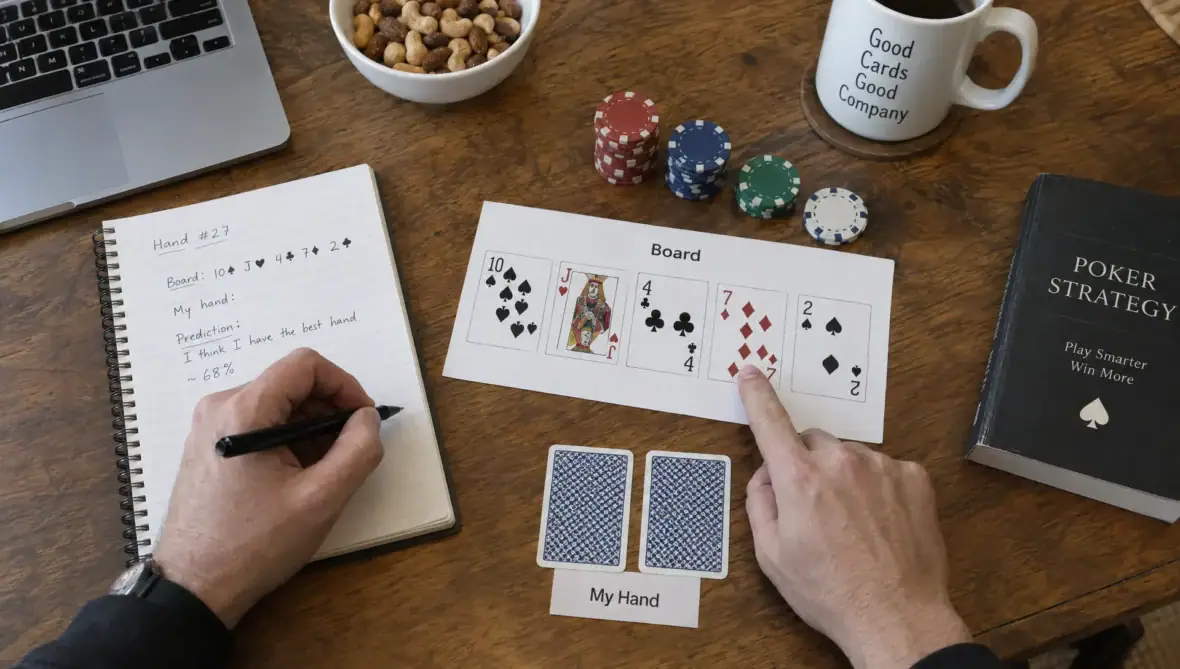
Free poker sites can help you practice hand reading without putting a bankroll at risk, provided you give each session a specific job. Instead of trying to guess an opponent’s exact cards, track which hands fit their actions and update that range as the board changes.
The goal is not to win the most play chips. It is to make a prediction before showdown, explain your reasoning and learn from the hands that challenge it. Here is a repeatable method for no-limit Texas Hold’em.
Build ranges, not exact-hand guesses
A range is the collection of hands an opponent could plausibly hold. Hand reading means updating that collection using position, betting actions, board cards and behavior you have actually observed.
Suppose someone raises before the flop and bets an ace-high flop. “They have ace-king” is a guess. A better starting point includes strong aces, other pairs, draws and bluffs, with different weights depending on the player and situation.
Think in three broad groups:
- Value hands: Hands that can reasonably expect calls from worse.
- Draws and potential bluffs: Hands that may improve or try to make stronger hands fold.
- Marginal showdown hands: Hands that can win at showdown but may not want a large pot.
These categories change during a hand. A draw can become the strongest hand on the river, while top pair can become a marginal bluff-catcher. Your job is to explain those changes rather than attach a permanent label to an opponent.
Choose free poker sites that make hands reviewable
The best practice environment is one where you can follow the action and inspect your reasoning afterward. A flashy lobby or a large starting chip balance does not help much with that task.
| Feature to look for | How it supports hand reading |
|---|---|
| Hand histories or a permitted replay function | Lets you reconstruct positions, bets and board cards |
| Consistent table sizes | Makes observations easier to compare across hands |
| Clear bet amounts and stack displays | Helps you interpret sizing relative to the pot |
| Private tables, if available | Allows controlled practice with willing partners |
| Manageable action speed | Gives you time to record a prediction before showdown |
Browser access can be convenient, but no download does not necessarily mean no registration. Check account requirements and whether the game actually offers the format you want to study. If the action is unfamiliar, review the basic Texas Hold’em betting rules first.
Also distinguish the products. Ordinary play-money chips generally cannot be redeemed. A freeroll is a tournament with no entry fee, but its prizes might be cash, tickets or restricted rewards. Sweepstakes-style products have separate coin categories and redemption conditions. Check current terms, age requirements and location eligibility rather than assuming “free” means cash prizes or nationwide availability.
For private rooms, check moderation controls and privacy settings before enabling voice or video.
Use the same range-narrowing routine every hand
To make free poker sites useful for deliberate practice, follow the same sequence: establish a starting range, update it after each action and record a prediction before seeing the cards. Start with one table so you have enough attention to do this properly.
Begin with position and observed behavior
Before the flop, record the opponent’s position, whether they raised or called and the effective stack, meaning the smaller stack between the players involved.
Position provides a starting assumption, not proof. A button raise can reasonably contain more hands than an early-position raise, but an individual player may behave differently. Record evidence such as “opened the button with 9♠6♠ at showdown” rather than immediately concluding “raises any two cards.”
Use broad categories initially: pocket pairs, strong broadway hands, suited aces, suited connectors and other hands supported by observations. Avoid a precise opening percentage unless you have enough information to justify it.
Your initial range should be wide enough to admit uncertainty. The later betting rounds are where you test it.
Update the range using the board and bet size
On free poker sites, ask what changed after each new card rather than treating every bet as an isolated signal.
A connected, two-heart flop supports different draws from a dry, rainbow flop. A small bet may fit a broad collection of hands, while a large bet may put more emphasis on strong value and bluffs. Those are starting interpretations, not universal rules.
For each action, identify which hands became more plausible, which became less plausible and which remain uncertain. Prefer “discount weak pairs after this large turn bet” to “remove every weak pair.” Play-money opponents can take unusual lines.
Include card removal in your reasoning. Cards in your hand and on the board reduce the combinations available to an opponent. An unblocked pocket pair has six combinations; a specific suited starting hand has four. You do not need to count everything immediately, but blockers should eventually influence your estimates.
Make a prediction before showdown
Before the river decision, write a short statement such as: “Mostly strong pairs and completed draws, with some missed straight draws.” Add a confidence level and the evidence behind it.
This prevents hindsight from rewriting your read. If you only explain the hand after seeing the cards, almost any action can seem obvious.
Do not spend chips merely to reveal a hand when your reasoning favors folding. You can review observed showdowns when other players reach them, or agree to discuss selected completed hands with a practice partner afterward.
Work through a complete hand
Use this example on free poker sites as a template for recording actions, not as a prescription for how every opponent plays.
Establish the action and possible ranges
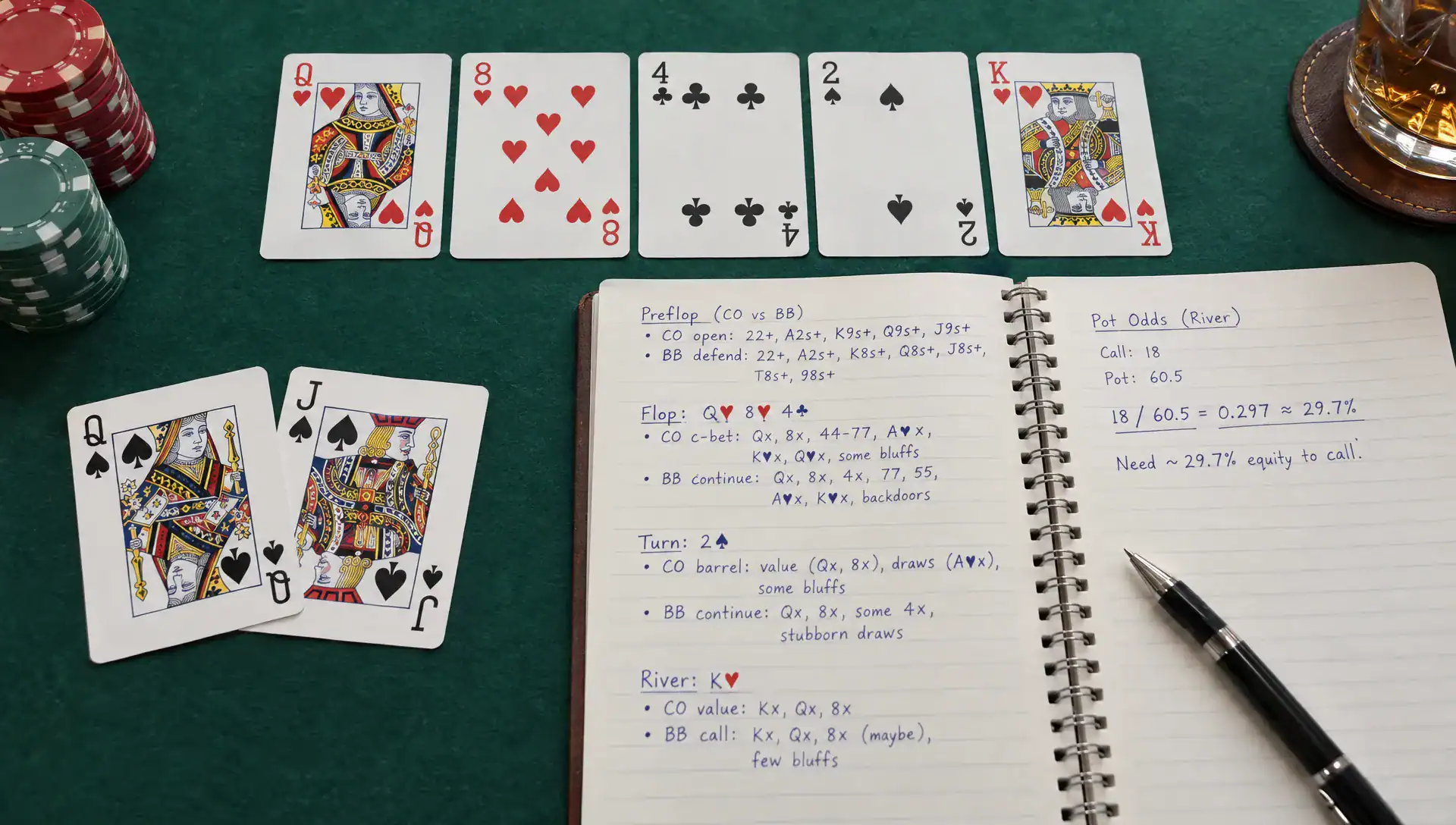
Assume a six-player table, 100-big-blind effective stacks, blinds of 0.5/1 and no antes or rake. Everyone folds to the button, who raises to 3 BB. The small blind folds and you call from the big blind with Q♠J♠.
| Street | Action | Pot after the action |
|---|---|---|
| Preflop | Button raises to 3 BB, you call | 6.5 BB |
| Flop: Q♥8♥4♣ | You check, button bets 2 BB, you call | 10.5 BB |
| Turn: 2♠ | You check, button bets 7 BB, you call | 24.5 BB |
The button’s preflop range might contain pairs, broadway hands, suited aces and suited connectors, plus other holdings supported by your observations.
The small flop bet does not identify one hand. Strong queens, overpairs, sets, heart draws and some bluffs can all fit. After the larger turn bet, give more consideration to strong made hands and draws, while discounting weaker hands that this player tends to check.
Reassess the river instead of defending your earlier read
The river is K♥. You check and the button bets 18 BB into 24.5 BB.
The third heart completes the flop flush draw. KQ is now two pair and your queen is no longer top pair. Some hands you beat earlier have improved, while missed non-heart draws may remain possible bluffs.
When practicing on free poker sites, write that board change down before deciding whether the opponent is “always bluffing.” Your Q♠J♠ contains no heart, so it does not block their possible flushes. Its ranks also remove some combinations from other parts of their range, including potential J-T bluffs.
The call costs 18 BB. The pot is currently 42.5 BB and would become 60.5 BB after your call:
Required equity = 18 ÷ 60.5 ≈ 29.8%.
You need to win about 30% of the time to break even on the call under these assumptions. That means evaluating plausible bluffs and worse value bets against hands that beat you. Pot odds set the threshold; they do not tell you the opponent’s range.
Without reliable behavioral evidence, this example does not establish an automatic call or fold.
Turn ordinary sessions into three targeted drills
Short, focused sessions on free poker sites make it easier to remember why you assigned a range. Try one drill at a time rather than attempting to track every opponent and every possible combination simultaneously.
Drill 1: Observe one opponent
For a 20-hand practice block, follow one player even when you fold. Record their position, preflop action, postflop sizing and any cards legitimately revealed at showdown.
Keep observation separate from interpretation. “Bet pot on the river and showed a missed flush draw” is an observation. “Uses large river bets with missed draws” is a hypothesis that needs more examples.
One showdown proves that a hand was possible. It does not establish how frequently the player takes that line. Likewise, a player who has not shown a bluff may still have bluffed in hands that never reached showdown.
Drill 2: Predict before a replay reveals the cards
If the platform provides a replay that lets you hide opponents’ cards, pause before the river reveal. Otherwise, use notes taken during play.
Name several plausible value hands, identify possible bluffs and choose a confidence level. Then reveal the result and compare it with your prediction.
A simple review log is enough:
| Hand | Prediction before reveal | What appeared | What to review |
|---|---|---|---|
| Example A | Strong top pairs, sets and missed draws | A missed draw | Was it included for a clear reason? |
| Example B | Mostly strong made hands | A weak pair | Did I narrow the range too aggressively? |
Do not score yourself only on whether the revealed hand appeared somewhere in an enormous range. Evaluate whether you assigned sensible emphasis to the possibilities.
Drill 3: Compare controlled practice with open tables
If free poker sites offer private tables, use them for an exercise with a willing partner. Play normally, record your separate reads and discuss selected hands only after they finish.
You can focus a session on single-raised pots or a particular board texture. Do not share live hole cards or coordinate against uninvolved players, and follow the platform’s rules on assistance and hand-history tools.
Heads-up practice produces frequent decisions, but it also changes normal starting ranges. Review these heads-up poker adjustments before treating a two-player session as a model for six-handed play.
Then return to an open table and test whether your assumptions still fit unfamiliar opponents.
Measure your reasoning, not your chip balance
Play-money results are a poor standalone measure of hand-reading skill. A correct read can lose to a later card, while a weak decision can win a large pot.
The most transferable lessons from free poker sites are the process skills: noticing position, reconstructing action, recognizing board changes and separating evidence from assumptions. The least transferable lessons are often population tendencies, such as how frequently a particular group calls large bets or bluffs the river.
After each session, review whether you made predictions before showdown, noticed completed draws and retained plausible bluffs. Look for repeated mistakes such as ignoring a player’s position or assuming that every large bet means the same thing.
Do not assume play-money opponents represent real-money opponents. Changing the stakes can change incentives and behavior, so any future move requires fresh observations rather than automatic trust in old reads.
Keep practice time-limited, avoid purchasing chips simply to continue a drill and check age and location rules before joining any platform.
Frequently asked questions
Can free poker sites actually improve hand reading? Yes, when you practice assigning ranges and reviewing decisions. They are useful for learning a repeatable process, but their players’ betting and bluffing frequencies should not automatically be applied to real-money games.
Should I call more often so I can see opponents’ cards? Not simply for information. Record your prediction, make the decision your reasoning supports and study available showdowns. Calling every time you are curious can reinforce poor habits.
Are freerolls better practice than play-money cash tables? They offer a different environment, not an automatic upgrade. Tournament stack sizes and elimination pressure affect decisions. Choose the format you want to study and avoid mixing tournament observations with deep-stacked cash-game assumptions.
What should I do when an opponent shows a hand outside my range? Identify which assumption excluded it. Perhaps the player opens wider than expected, calls with weak draws or uses an unusual bet size. Update that specific hypothesis without assuming everyone at the table behaves similarly.
Start with one reviewable session
Choose one table, observe one opponent and save three hands for review. For each hand, record your range before showdown, the evidence behind it and one assumption you would change.
If you need supporting study material, explore Rakeback Bible’s free poker books. Keep the next session focused on applying one concept rather than collecting more advice without testing it.
Author