
Internet Poker vs. Live Poker for Low-Stakes Players

Internet poker and live poker can share the same rules while asking very different things of your wallet. A small online cash game might let you sit down with a few dollars, whereas a casino’s lowest available game could require a much larger buy-in. For low-stakes players, that difference matters more than the atmosphere or the advertised rewards.
The right comparison is not simply which game looks easier. It is how much money you must risk, what each session costs and whether the pace suits your experience. Availability and legal access matter too, especially for US players.
The short answer: Online play usually offers more flexibility for a small budget. Live play offers face-to-face interaction and fewer hands to process, but can require a bigger bankroll and additional spending. Neither format makes poker a reliable source of income.
How internet poker compares with live games
The differences below are useful starting points, not promises about every poker room. Stakes, fees and game availability depend on the operator, venue and location.
| Factor | Online cash games | Live cash games |
|---|---|---|
| Entry stakes | Microstakes may be available | The lowest available blinds are often higher |
| Buy-in flexibility | Smaller dollar buy-ins may be possible | A standard stack can require substantially more cash |
| Playing pace | Automated dealing generally produces more hands | Physical dealing and chip handling slow the game |
| Opponent information | Betting patterns, timing and permitted account history | Betting patterns plus physical behavior and conversation |
| Extra expenses | Possible payment, currency conversion or withdrawal fees | Possible travel, parking, food and tips |
| Rewards | Rakeback or bonuses may be offered | Comps or promotions may be offered |
| Session flexibility | No travel, but active hands still require attention | Travel and waiting lists can extend the outing |
For a budget-conscious beginner, the most important rows are entry stakes and buy-in flexibility. Rewards should come later in the decision. A generous promotion does not make a game affordable if the normal swings already exceed your spending limit.
Compare the dollars at risk, not just the label
The biggest financial advantage of internet poker is access to smaller stakes where those games are legally available. “Low stakes” is relative: an online microstakes table and a casino’s smallest game can involve very different amounts of money.
Consider these illustrative cash-game examples, assuming a player chooses a stack of 100 big blinds:
| Blinds | Value of 100 big blinds |
|---|---|
| $0.02/$0.05 | $5 |
| $0.10/$0.25 | $25 |
| $1/$2 | $200 |
These are arithmetic examples, not advertised games or minimum buy-ins. Each room sets its own buy-in rules.
If your entire entertainment budget is $100, putting $100 into a live game is not equivalent to playing a $5 online stack. One difficult hand could consume the whole budget in the former. The smaller game gives you more room to learn without exposing as much money at once.
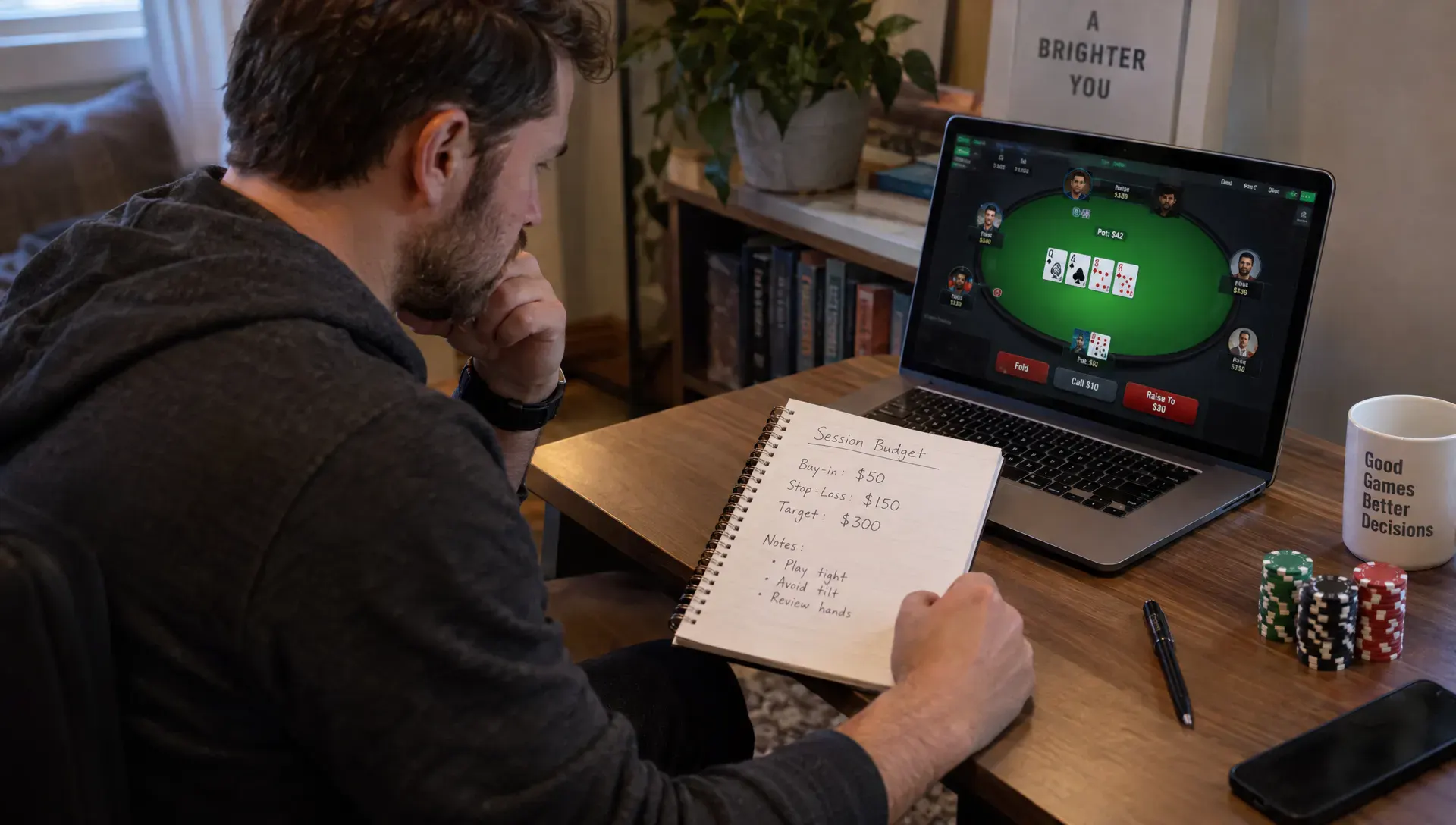
That does not mean you should repeatedly reload online. Set a cash loss limit before starting, keep poker money separate from essential expenses and stop when the limit is reached. A deposit limit can help prevent a planned small session from becoming a larger one.
There is no universal number of buy-ins that guarantees safety. Experience, game type and playing style all affect results. If losing the amount would affect bills or savings, the stakes are too high.
Pace and difficulty: more hands are not automatically better
Internet poker generally deals faster because software handles shuffling, pot calculations and payouts. That makes it convenient for practice, but also means mistakes can accumulate quickly.
For a simple planning exercise, suppose you play 25 hands an hour live and 70 hands an hour at one conventional online table. Those are assumptions, not guaranteed room averages. Over two hours, you would face roughly 50 decisions involving dealt hands in one setting and 140 in the other.
More volume can provide useful experience. It can also turn loose calls or impulsive bluffs into a larger session loss. Adding tables increases that exposure further, so beginners are better served by learning to make clear decisions at one table first.
Opponents matter more than the setting
Do not assume a live game is automatically soft or that every online table is full of specialists. Player pools vary by stakes, time and location. At comparable dollar stakes, online players may have considerable experience, but a particular table can differ sharply from that expectation.
Watch observable behavior: how often players enter pots, whether they respect position and how they size bets. Rakeback Bible’s guide to choosing an easier poker table explains selection signals where lobby information is available.
A comfortable pace and an affordable game are more useful starting criteria than confidence that you can outplay strangers.
Count session costs before valuing rakeback
Internet poker avoids the journey to a cardroom, but it is not free to play. Operators typically collect rake from eligible cash-game pots or charge tournament fees. Payment costs can add another layer.
Live games also charge for participation, commonly through pot rake or a time charge. Depending on the venue, there may be additional promotional drops. Travel, parking, refreshments and voluntary dealer tips belong in your personal session budget even though they are not all poker fees.
Suppose a live outing involves $12 in transport and $8 in food you would not otherwise have bought. That is $20 spent before considering your result at the table. A shorter online session may avoid those expenses, though its actual payment terms still need checking.
Treat rewards as a reduction in cost
For illustration, $12 of eligible rake with a fully realizable 20% return produces $2.40 in rewards. It does not produce $2.40 of profit if your playing losses are larger.
Check eligibility, expiration dates, release requirements and withdrawal restrictions. A headline rate may not apply to every game or every dollar of rake. Likewise, a live meal comp has limited value if earning it requires spending longer at the table than you intended.
For the mechanics, use the guide to comparing poker platforms by their true costs. For this decision, the key rule is simpler: compare the sessions you actually intend to play, not the maximum rewards advertised.
Choose the environment that supports good habits
The convenience of internet poker is valuable when it helps you stick to a short, planned session. It becomes a disadvantage if instant access leads to distracted play or repeated deposits.
A quiet setup, one table and a fixed finishing time can make decisions easier to review. Where the room provides hand histories, use its permitted tools to revisit uncertain spots. Check the operator’s rules before using any third-party software or assistance.
Live poker offers a different learning experience. You handle chips, announce actions and follow betting without software enforcing every step. Conversation can make an evening more enjoyable, but it can also distract you from the pot or encourage you to stay longer.
Physical tells are not a substitute for sound decisions. Position, bet sizing and the likely strength of an opponent’s range remain relevant in both settings.
If you are still learning the controls and betting sequence, free poker can help you practice before depositing. Treat it as a mechanics lesson rather than evidence you will win for money. Play-money opponents have different incentives, and their willingness to call large bets may teach misleading lessons about real-money games.
Check legal access and player protection first
For US players, internet poker availability depends on state law, the operator and your physical location. Being able to download an app or open its website does not establish that real-money play is authorized where you are.
Check current information from your state regulator. For example, the New Jersey Division of Gaming Enforcement provides official information about gambling regulation in that state. Do not assume an operator approved in one jurisdiction is authorized in another.
Before depositing, check these practical safeguards:
- Authorization: Verify the operator and relevant license through the regulator, not just a logo on the site.
- Game integrity: Look for published testing information and clearly explained policies on collusion, bots and prohibited assistance.
- Payments: Read identity-verification requirements, withdrawal limits, processing terms and possible fees.
- Account protection: Use a unique password and enable two-factor authentication where available.
- Spending controls: Look for deposit limits, time-outs and self-exclusion options.
Testing does not guarantee that cheating can never occur. Clear complaint procedures and meaningful regulatory oversight also matter. An offshore license is not equivalent to authorization from your state regulator.
Distinguish real-money rooms from social poker apps as well. In a conventional play-money app, purchased chips generally cannot be withdrawn as cash. Sweepstakes-style products have different terms and legal questions, so do not assume all poker apps offer the same protections or redemption rights.
Pick the format that fits your actual session
Internet poker is often the more practical starting point when your budget is small, transport is inconvenient or you want to practice at very low dollar stakes. That advantage depends on finding a lawful, suitable room and maintaining spending limits.
Live play may fit better when the social experience is part of what you are buying and the available stakes are comfortably affordable. A local cardroom can be an enjoyable outing without needing to outperform an online alternative financially.
Before choosing, write down three figures: your maximum session loss, your non-poker expenses and the time you can realistically commit. Then check whether the available game fits all three. Do not increase the budget simply because the venue’s smallest game is larger than expected.
You can also separate your goals. Practicing mechanics at tiny stakes and occasionally visiting a cardroom are different activities with different budgets. Neither requires moving up in stakes.
Cash games and tournaments need separate planning, too. A cash player can usually leave after completing a hand, subject to room rules. A tournament may continue far longer than expected, and leaving means surrendering your chance to compete for the remaining prizes. Re-entries can also make the advertised buy-in a poor guide to total spending.
Frequently asked questions
Is internet poker cheaper than live poker? It can be, particularly when microstakes are available and you avoid travel expenses. However, faster play, multiple tables and repeated deposits can increase total spending. Compare your planned session costs rather than assuming that playing from home is automatically cheaper.
Are live low-stakes games easier to beat? Some contain inexperienced players, but there is no dependable rule. Opponents, rake and your own decisions determine the challenge. A friendly table can still be expensive if its blinds are too large for your budget.
Do online and live poker use the same rules? The core rules of a particular variant are generally the same. Procedures differ, including action timers, bet announcements, missed blinds and how disputes are handled. Read the house rules before playing.
Should a beginner choose cash games or tournaments? Cash games provide more control over session length. A tournament offers a defined initial entry cost, but re-entries and add-ons can increase spending. Choose based on both your budget and the time commitment, not the size of the advertised prize pool.
What if I keep exceeding my planned budget? Stop playing and use available account restrictions or self-exclusion tools. The National Council on Problem Gambling provides information about support resources. Poker should not be used to recover losses or solve financial problems.
Compare the deal only after choosing an affordable game
Once you know internet poker suits your location, budget and habits, use Rakeback Bible to compare room reviews, rakeback deals and bonus terms. Prioritize legal access, suitable stakes and clear withdrawal conditions before rewards.
If live poker is the better fit, include the full outing cost in your limit. The better low-stakes choice is the one you can enjoy without putting essential money at risk, not the one promising the biggest return.
Author