
What Free Poker Can Teach You Before You Deposit
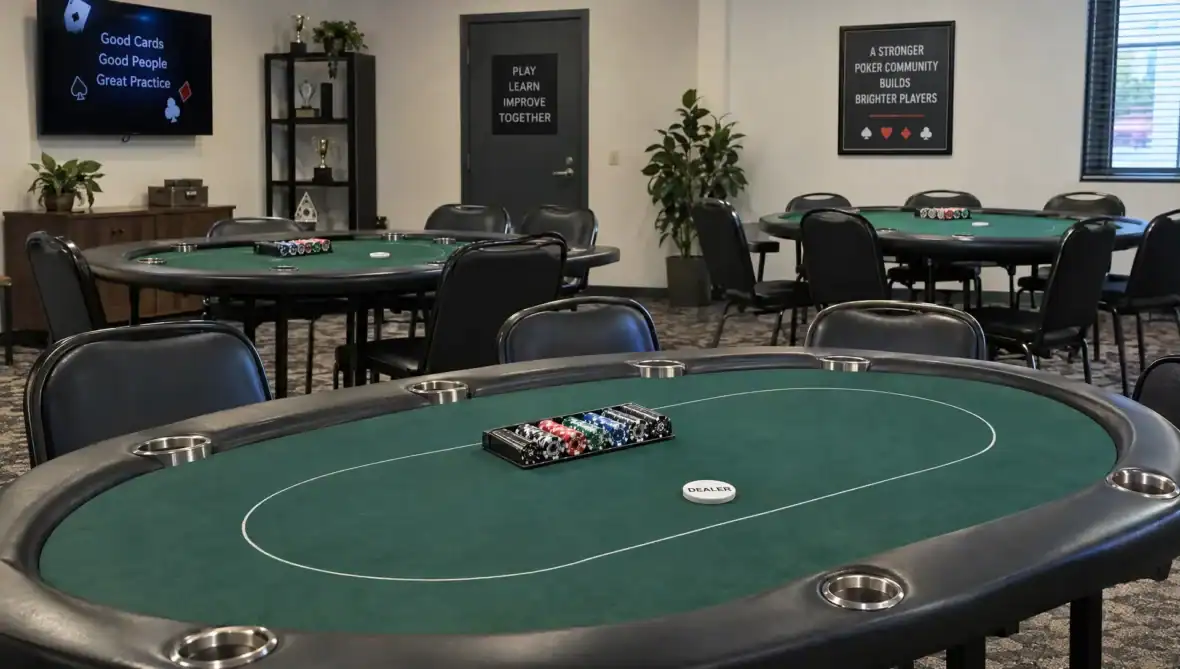
You can learn a lot from free poker before risking a dollar, but winning virtual chips is not the same as being ready for real-money games. The useful lessons are more specific: understanding the action, making decisions in consistent units, recognizing bad habits and learning how you respond when a hand goes wrong. Treat practice as a way to test your process, not prove that you will make money.
Start by identifying what is actually free
Different no-cost formats teach different things. Before joining a table, check whether you are playing for virtual chips, competing for a prize or simply completing a tutorial.
| Format | What it can help you practice | What to check |
|---|---|---|
| Play-money tables | Betting order, position, sizing and software controls | Whether virtual chips have any cash value and whether chip purchases are optional |
| No-entry-fee tournaments, often called freerolls | Blind increases, stack management and tournament decisions | Entry qualifications, prize terms and any withdrawal requirements |
| Guided tutorials or practice modes | Rules, hand rankings and basic decisions | Whether situations are guided rather than representative of ordinary play |
A game can be free to enter while still selling chip packages. Likewise, a tournament with no entry fee may have qualification requirements involving previous activity. Check the terms rather than assuming that “free” means no spending, no restrictions or withdrawable winnings.
For learning purposes, you do not need to buy virtual chips. If a platform repeatedly pushes you to purchase more, another practice format may suit you better.
Four skills free poker can teach before you deposit
1. Following the action without interface mistakes
Your first objective is to understand what is happening before deciding what to do. Know whose turn it is, how much you must call and whether the amount shown on a raise button means the total bet or an additional amount.
Practice at one table until you can follow a complete hand without rushing. Notice how the dealer button moves, when the blinds are posted and how your position changes across hands. If any of that is unfamiliar, review the basic rules of Texas Hold’em before adding more decisions.
Software familiarity matters too. Locate the sit-out control, understand the action timer and learn whether a preselected action can execute after the situation changes. Avoiding an accidental call is a useful learning outcome even when no money is involved.
2. Thinking in big blinds and starting-hand ranges
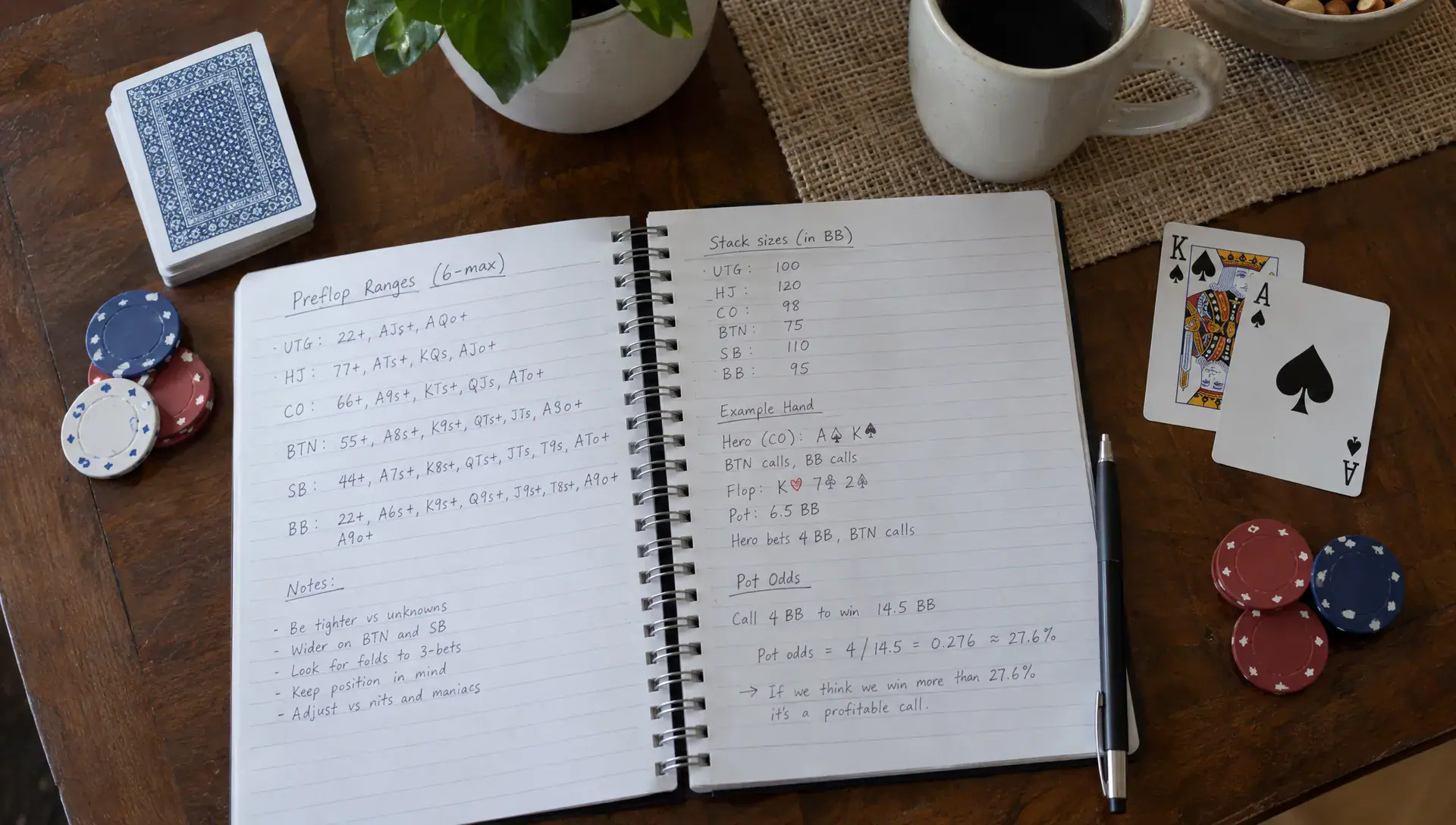
A stack of 2,000 chips means little without knowing the blinds. With blinds of 10/20, that stack is 100 big blinds. With blinds of 100/200, it is only 10 big blinds, which creates very different decisions.
Use free poker to make this conversion automatic. Record stack sizes and opening raises in big blinds rather than treating large chip numbers as impressive.
Then connect your starting-hand choices to position. Acting later gives you more information about what other players have done. Instead of memorizing one list of “good cards,” notice how your decision changes with position, previous action and effective stack size, meaning the smaller stack between you and the opponent involved.
A useful review question is: “Would I make the same decision with this hand from every seat?” If the answer is always yes, you may be overlooking information that matters.
3. Comparing the price of a call with your chance of winning
Practice chips are sufficient for learning pot odds because the arithmetic does not depend on whether the chips represent dollars.
Suppose the pot contains 100 chips and an opponent bets 50. There are now 150 chips available, and calling costs 50. After your call, the pot would contain 200 chips, so the call represents 25% of that final pot.
In a simplified situation with no further betting and no rake, you need 25% equity to break even on the call. That does not mean every draw is worth chasing.
For example, a nine-out flush draw with one card to come has roughly a 19.6% chance of completing, assuming all nine outs are available and make you the winner. That falls below the immediate price in this example. Possible future winnings can change the analysis, but they are not guaranteed.
The site's guide to pot odds, outs and expected value provides more background. During practice, start by identifying the pot, the price and the assumptions behind your decision.
4. Adjusting to behavior rather than judging appearances
Some practice opponents call almost anything. Others play cautiously or make oversized bets. Observe what a particular player does instead of assuming everyone approaches the game the same way.
Free poker can teach you to distinguish an observation from a guess. “This player called three large bets with weak hands” is evidence. “This player looks reckless because of their avatar” is not.
Against someone who rarely folds, bluffing repeatedly is unlikely to achieve much. You can practice betting stronger hands for value and declining to force action with weak ones. Against a more selective opponent, different opportunities may appear.
The transferable skill is the adjustment process: observe, form a tentative explanation and update it when new hands contradict it. Do not assume a strategy that beats one practice table will work unchanged elsewhere.
What play-money results cannot prove
A large virtual bankroll does not establish a profitable real-money win rate. When chips are easily replaced, players may call, gamble or experiment in ways they would avoid with money at stake. That changes the situations you face and the strategies that succeed.
Practice also cannot fully reproduce financial pressure. You might comfortably fold a strong-looking hand with virtual chips yet struggle with the same decision after losing money. Conversely, a frustrating practice session can reveal impatience before there is a financial consequence.
Short-term results are another limitation. Winning several sessions can come from favorable cards, while sound decisions can still lose. Review the reasoning behind important hands rather than treating your balance as a report card.
Tournament results need similar caution. A freeroll can introduce rising blinds and elimination pressure, but its field, payout structure and entry incentives may differ substantially from a paid tournament. It teaches parts of the format, not everything about the next game you might enter.
Give each practice session one job
Playing more hands is not automatically better practice. A focused session gives you something specific to evaluate afterward, even if you finish with fewer chips.
Try the following sequence as a learning exercise, not a qualification test for depositing:
| Session focus | What to do | What to review afterward |
|---|---|---|
| Mechanics | Follow every action and identify your position before acting | Misclicks, missed action and unclear betting amounts |
| Starting decisions | Note your position, hand and effective stack before entering a pot | Hands played without a clear reason |
| Calling decisions | Estimate the price before making a significant call | Calls justified only by hoping to improve |
| Emotional control | Set a stopping time and notice your response to losing hands | Chasing, rushed decisions and abandoned plans |
After each session, record one decision you understood and one you want to investigate. A short note such as “called because I did not want to be bluffed” is more useful than “lost with a pair.” It identifies a thought process you can examine.
The value of free poker grows when you review hands away from the table. If hand histories are available, save a few difficult spots. Otherwise, write down the cards, position, stack sizes and betting sequence as accurately as possible.
Do not use a fixed number of sessions or a target chip balance as proof of readiness. The aim is to reduce confusion and identify limits, not award yourself a passing grade.
Before depositing, check the costs and safeguards practice leaves out
Understand rake and reward conditions
Real-money poker has costs that ordinary play-money results may not reflect. Cash games commonly charge rake according to the room's rules, while tournaments typically disclose an entry fee or other charge. Structures vary, so inspect the actual terms for the game you intend to play.
Rakeback and bonuses can reduce some costs, but a headline percentage does not tell you what you will receive. Check eligible games, how rewards are calculated, any caps, expiration dates and clearance requirements.
Success at free poker does not establish that higher volume will make a reward worthwhile. Do not increase your spending or playing time simply to chase a promotion. A reward is not a guarantee of profit.
Make the safety decision separately
Before any deposit, confirm that the operator is authorized to offer real-money poker where you are physically located and that you meet its age and account requirements. Check identity-verification procedures and withdrawal terms before sending money.
Keep these safeguards separate from how well you think you play:
- Use only money you can afford to lose, never funds needed for bills, savings goals or debt payments.
- Set spending and time limits in advance, using account controls where available.
- Do not borrow to play or deposit more to recover losses.
- Stop if poker begins affecting your finances, sleep, relationships or ability to follow your limits.
These are boundaries, not a system for making gambling safe or profitable. You can continue learning without ever depositing. If controlling play becomes difficult, the National Council on Problem Gambling provides information about support resources in the US.
Frequently asked questions
Can free poker make you a better player? It can improve rules knowledge, software familiarity, basic calculations and decision review. Its usefulness depends on how deliberately you practice. It is less reliable for measuring how opponents behave when money matters or how you will respond to financial losses.
Are freerolls the same as play-money games? No. Play-money games generally use virtual chips without cash value. Freerolls are tournaments without an entry fee and may award cash, tickets or other prizes. Eligibility and prize conditions vary, so verify the current terms before entering.
How do I know whether I am ready to deposit? No practice result can establish that you are financially or emotionally ready. Understanding the rules and costs, meeting legal requirements and setting affordable limits are prerequisites, not guarantees. Choosing not to deposit remains a valid decision regardless of your skill.
Should I buy virtual chips to keep practicing? You do not need to. Check whether the platform offers free replenishment, use another no-cost practice option or study hands away from the table. Buying chips can turn a supposedly free learning activity into recurring spending without improving the quality of your practice.
Compare the terms, not just the headline offer
If you independently decide to explore real-money play, use Rakeback Bible's poker-room and rakeback comparisons to compare offers, then verify the current conditions with the operator. Prioritize legal availability, game costs and withdrawal terms before promotional rewards. Your practice should help you ask better questions before depositing, not give you a reason to rush.

90 days after eligible first deposit to unlock full bonus. Withdrawal restrictions apply.
18+ | Further Terms Apply | Play Safe | www.begambleaware.org | #ad

18+ | Further Terms Apply | Play Safe | www.begambleaware.org | #ad

18+ | Further Terms Apply | Play Safe | www.begambleaware.org | #ad