
How to Compare Online Poker Platforms by Their True Costs

Comparing online poker platforms by their biggest advertised bonus can lead you to the wrong room. A generous reward percentage may apply to only part of your rake, expire before you qualify or come with payment costs that reduce its value.
The better comparison is effective cost: the fees attributable to your play, minus rewards you can realistically earn and withdraw. That calculation should reflect your stakes, format, monthly volume and banking method, not a promotional maximum.
Two rooms can charge the same headline rake percentage yet produce different bills because their caps, player-count rules and reward systems differ. Tournament players face another set of questions, including entry fees, re-entries and optional add-ons.
This guide explains how to build a like-for-like cost comparison, distinguish genuine savings from conditional promotions and avoid counting the same benefit twice. All numerical examples below are hypothetical, not current offers from particular operators.
Compare online poker platforms only after checking access
A cheap room is not a useful option if you cannot legally play there or reliably withdraw your balance. For US players, availability must be checked by state rather than treating the country as one market.
Start with the relevant state regulator. For example, the New Jersey Division of Gaming Enforcement and Michigan Gaming Control Board publish information about regulated internet gaming. Verify the specific operator and website, not just a familiar brand name or a license logo in its footer.
Check whether you must be physically located within an authorized state, what age requirement applies and which identity documents are required. An offshore license does not establish authorization in your state, and a site accepting your registration does not establish legality.
Also distinguish real-money poker from play-money games, social poker and sweepstakes products. Their payment structures, redemption rules and consumer protections differ, so they should not share one cost comparison.
Treat legal access, operator identity and withdrawal eligibility as pass-or-fail checks. A lower fee does not compensate for uncertainty about whether you can access your funds.
Build a cost ledger before comparing offers
The most useful way to assess online poker platforms is to separate charges from incentives before calculating a net figure.
| Cost category | What to record | Common comparison mistake |
|---|---|---|
| Cash-game rake | Rate, cap, player-count rules and attributed rake | Comparing percentages without caps |
| Tournament fees | Operator fee and total entry payment | Treating the prize-pool contribution as a fee |
| Extra game charges | Any jackpot, promotional or other separate deduction | Assuming the headline rake includes everything |
| Rewards | Cash-equivalent value actually earned and usable | Using the maximum advertised percentage |
| Banking | Deposit, withdrawal, network and conversion costs | Checking only the deposit fee |
| Conditional charges | Applicable inactivity, account or other fees | Assuming every listed fee applies to your usage |
For a defined period, use this working formula:
Estimated net platform cost = attributed rake + tournament fees + other applicable charges + payment costs − realizable rewards.
This is a fee comparison, not a prediction of poker profit. Winnings and losses against other players belong in a separate performance record. Taxes also require separate treatment according to your circumstances and jurisdiction.
Use one currency throughout, keep supporting records and label estimates. An incomplete but transparent calculation is more useful than a precise-looking total built from incompatible figures.
Cash-game rake: compare the rate and the cap together
Cash-game rake is commonly taken from qualifying pots, often as a percentage subject to a maximum. The exact schedule can vary by stake, format and number of players.
When comparing online poker platforms, record the rules for the games you actually intend to play. A room’s attractive high-stakes schedule tells you little about its micro-stakes costs.
Consider two hypothetical tables charging 5% rake. One caps the deduction at $1 and the other at $2. On a qualifying $10 pot, both take $0.50. On a qualifying $50 pot, the first takes $1 and the second takes $2. The advertised percentage is identical, but the larger-pot cost is not.
Check how the room defines player count, too. A heads-up cap may differ from the cap for a full table, and the relevant count may depend on the operator’s rules rather than simply the table’s maximum seats.
Other details matter: rounding, minimum qualifying pots, whether rake is collected when no flop is dealt and any separate promotional deductions. Save the published schedule with your comparison so you can revisit the assumptions if terms change.
Keep rake attribution separate from reward attribution
The rake removed from an entire pot is not automatically your personal cost. Rooms and tracking tools can allocate it using different methods, including dealt or contributed approaches.
A contributed method generally allocates rake according to money put into the pot. A dealt method can distribute credit among players dealt into the hand. Definitions and implementation vary, so verify the actual rules.
To compare online poker platforms consistently, use the same attribution basis where possible and record the method beside each figure. Otherwise, an apparent cost difference may partly reflect different accounting.
Do not assume that the rake shown in a rewards dashboard matches the figure used by your tracking software. If a room does not explain how it calculates qualifying rake, treat the resulting reward estimate as uncertain rather than filling the gap with an assumption.
Value rewards at what you can actually receive
A headline rakeback rate is not enough. Establish what activity qualifies, how rewards are calculated and whether the payout is cash, tournament tickets, restricted credit or a variable prize.
A practical comparison of online poker platforms should use realizable rewards, not the largest number visible on a promotional banner. Deduct exclusions and account for deadlines, thresholds and any withdrawal restrictions.
For a fixed cash reward, calculate:
Realized rakeback rate = withdrawable reward earned ÷ relevant qualifying rake × 100.
If $300 of qualifying rake produces $45 of withdrawable cashback, the realized rate is 15%. That does not prove the offer applies to other games, higher volumes or future periods.
Translate bonus terms into your expected volume
Suppose a hypothetical $300 welcome bonus releases $10 for every $50 of qualifying rake. Generating $300 of that rake before expiry would release $60, not the full $300. The rest has no value in your comparison unless you realistically expect to unlock it.
Check whether the bonus stacks with ongoing rewards or replaces part of them. Two promotions funded from the same reward balance cannot both be counted in full.
Tournament tickets deserve separate treatment. If you would not otherwise enter that event, the ticket’s face value is not equivalent to cash savings. Likewise, rank-based leaderboards and variable rewards should not be entered as guaranteed income.
Avoid increasing play or stakes just to reach a reward tier. Additional fees, playing losses and time can exceed the incremental reward.
A worked comparison using the same stakes and volume
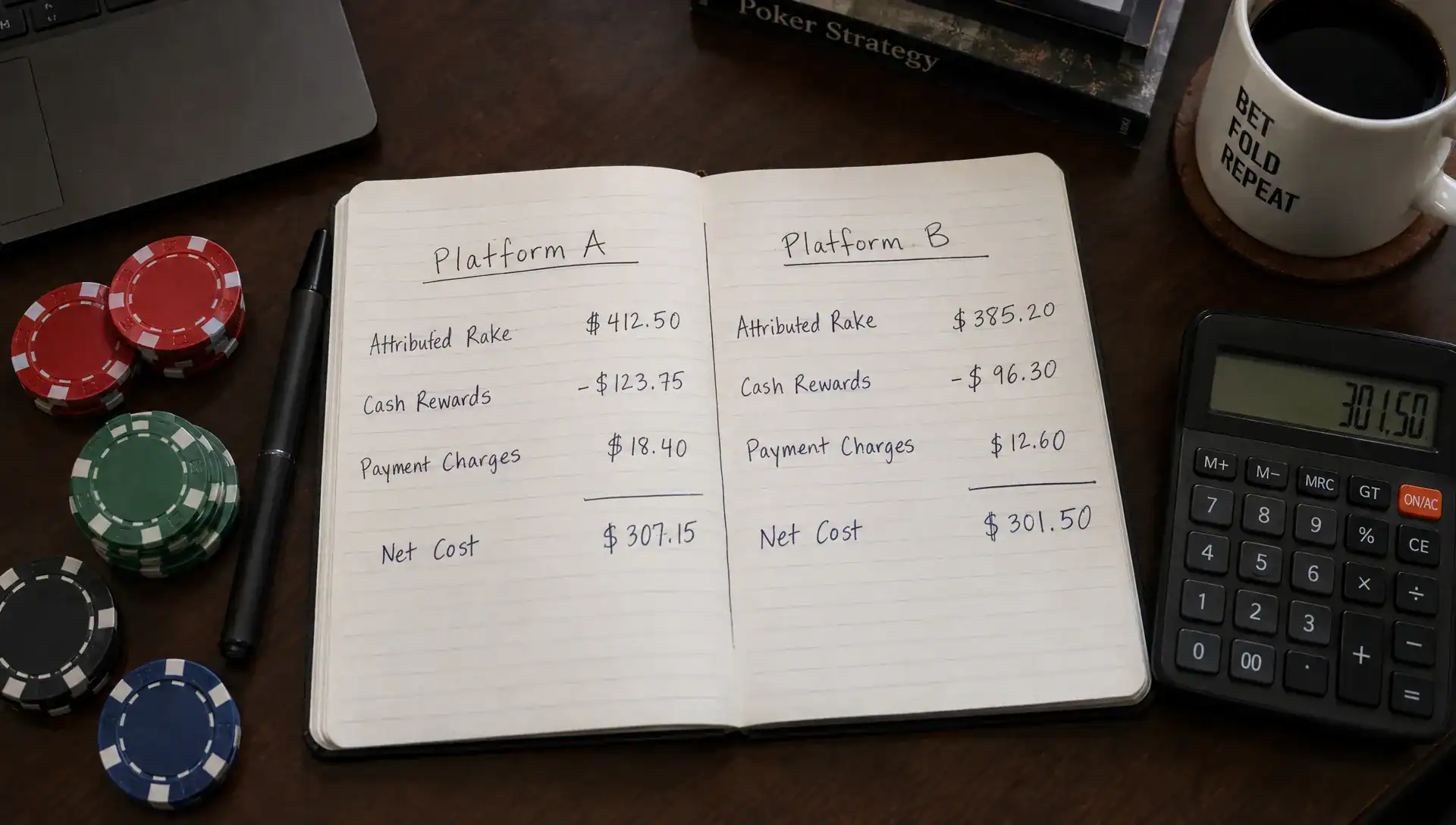
The following example shows why online poker platforms with higher reward percentages are not necessarily cheaper. Both hypothetical rooms are assessed over 20,000 hands at $0.25/$0.50, using a consistent attributed-rake method and comparable play.
Rewards are assumed to be earned, withdrawable cash. No unearned bonus or speculative leaderboard payment is included.
| Monthly measure | Room A | Room B |
|---|---|---|
| Attributed cash-game rake | $450 | $390 |
| Realized reward rate | 20% | 10% |
| Cash rewards received | $90 | $39 |
| Total applicable payment costs | $15 | $10 |
| Net platform cost | $375 | $361 |
| Net cost in big blinds per 100 hands | 3.75 | 3.61 |
Room A returns more cash, but Room B still costs $14 less over the sample. The lower gross rake outweighs Room A’s reward advantage.
To express cash-game cost in big blinds per 100 hands, use:
Net cost in bb/100 = net dollar cost ÷ dollar value of one big blind ÷ hands played × 100.
For Room A, that is $375 ÷ $0.50 ÷ 20,000 × 100 = 3.75 bb/100.
This unit makes fee comparisons easier, but it is not a win-rate forecast. If your tracked results already include rake, do not subtract that rake again. Add rewards separately only if they are not already included in those results.
Tournament fees need a separate calculation
Tournament players should compare the amount going to the prize pool with the amount retained as an operator fee. Display conventions vary, so confirm the breakdown rather than interpreting a single entry price.
A hypothetical tournament listed as $10 + $1 contributes $10 to the prize pool and charges a $1 fee. The fee equals 10% of the prize contribution, but approximately 9.09% of the total $11 payment. Both figures are mathematically valid; mixing them makes comparisons misleading.
When assessing online poker platforms for tournaments, choose one denominator and apply it consistently. Also compare similar formats and entry levels rather than a low-fee special event against another room’s regular schedule.
Re-entries increase total spending and normally incur another entry fee under the event’s rules. However, the entire re-entry payment is not an operator charge. The same distinction applies to add-ons and bounty components: identify what goes to prizes and what the operator retains.
Track total tournament payments and total fees separately. A low fee percentage does not make repeated entries affordable or reduce the uncertainty of tournament results.
Calculate the full deposit-to-withdrawal cost
A free deposit does not establish that banking is free. Compare the entire route from your funding account into the poker room and back to a currency you intend to spend.
Possible charges include payment-provider fees, withdrawal charges, currency-conversion spreads, intermediary costs and blockchain network fees. Some are fixed, some proportional and some depend on the route used.
For online poker platforms supporting cryptocurrency, include any exchange and conversion steps you actually need. An asset described as a stablecoin can still involve conversion costs and issuer or custody risks. Check the supported asset and network carefully; incompatible transfers can result in lost funds.
Estimate costs using your expected transaction pattern. Several small withdrawals can cost more than one larger withdrawal when a fixed fee applies. That arithmetic is not a reason to leave more money on a site than you are comfortable risking.
Withdrawal minimums, processing rules and identity checks also affect access to your balance, even when they carry no explicit fee. Complete required verification early and confirm the permitted withdrawal route before depositing.
Do not count the same conversion twice if it is already included in a provider’s quoted all-in amount.
Account for traffic, software and your time
The cheapest published schedule may be a poor fit if your preferred games rarely run. Observe available tables at the hours you expect to play and check whether those tables match your stakes and format.
Traffic also changes the relevance of the rake schedule. A room may offer favorable full-table caps, yet your actual sessions may mostly be short-handed. Your estimate should follow the games available to you, not an ideal lobby snapshot.
Comparing online poker platforms therefore requires a second assessment alongside fees: usability. Test permitted software features, connection stability, mobile controls if relevant and access to records you need for your own accounting.
Faster play is not automatically better value. More hands per hour can increase hourly rake exposure and the pace of losses. Similarly, reward tasks can consume time without producing enough additional value to justify them.
Opponent strength affects results, but it is not a platform fee and cannot be reliably converted into guaranteed earnings. Rakeback Bible’s guide to using lobby statistics to evaluate poker tables provides context for table selection without replacing the cost calculation.
Use a repeatable comparison worksheet
Choose a realistic monthly scenario before evaluating offers: stakes, format, hands or tournament entries, funding currency and expected withdrawals. Base volume on play you already intend to undertake, not on the amount needed to unlock a promotion.
Then collect each room’s current fee schedule, reward terms and banking rules. Rakeback Bible’s poker room reviews can help you identify candidates and questions to investigate, but confirm material terms with the operator before depositing.
Your worksheet for online poker platforms should retain these essentials:
- Access and protection: Applicable authorization, operator identity and verification requirements.
- Game costs: Relevant rake schedule, tournament fees and separate deductions.
- Realizable rewards: Expected eligible cash value, deadlines and exclusions.
- Banking costs: The full funding and withdrawal route in one currency.
- Evidence: Links or saved terms, calculation date and unresolved questions.
Calculate a conservative case that excludes uncertain promotional income. If a room looks competitive only after winning a leaderboard or reaching an unfamiliar volume tier, that is a fragile basis for choosing it.
Once you have actual records, replace estimates with observed costs. Recheck after changes to stakes, volume, reward status or payment methods.
Frequently asked questions
Is the room with the highest rakeback always cheapest? No. A larger rebate can be offset by higher gross rake, extra deductions or payment costs. Compare the net amount over the same stakes, format and expected volume.
Can I compare cash games and tournaments with one percentage? Not meaningfully without defining the denominator. Cash-game rake and tournament entry fees are charged differently. Calculate each separately, then combine dollar costs if you play both formats.
How much is a welcome bonus worth? Count only the portion you can realistically release before expiry under its qualifying rules. Check whether it replaces other rewards and whether released funds are withdrawable. Do not treat the advertised maximum as cash already earned.
Should I count poker losses as platform fees? No. Losses against other players are separate from fees. However, both affect your bankroll, and a low-cost room does not make poker profitable or safe to treat as income.
How often should I reassess online poker platforms? Recalculate when the operator changes its terms or your own playing pattern changes. A different stake, shorter-handed game mix or new withdrawal route can alter which room has the lowest effective cost.
Compare the net cost before depositing
Use Rakeback Bible to explore poker room comparisons, then verify the terms relevant to your own play. Choose among legally available options using realizable rewards and complete costs, not promotional headlines.
Set affordable deposit, loss and time limits. Never increase stakes or chase losses to qualify for cashback; no reward makes unaffordable gambling worthwhile.
Author