
Choosing the Best Poker Apps for Hand History Reviews


The best poker apps for hand history reviews are not necessarily the ones with the slickest tables or biggest welcome bonuses. They are the apps that let you recover complete hands, understand the action and move useful information into a repeatable study routine without breaking the poker room’s rules.
That distinction matters if you play on your phone but study on a computer, switch between cash games and tournaments or want to check whether rake is eroding your results. Before depositing, evaluate the entire path from playing a hand to reviewing the decision. A polished replay screen is only one part of that process.
Build your shortlist around reviewable data
A useful hand history should let you reconstruct the decision using information available at the time. Seeing your hole cards and the final pot is not enough if stack sizes, positions or earlier bets are missing.
| Information to check | Why it matters during review |
|---|---|
| Game type, stakes and table size | Establishes the strategic context and betting structure |
| Positions and starting stacks | Determines effective stacks, positional advantage and available bet sizes |
| Blinds, antes and forced bets | Allows accurate pot reconstruction |
| Actions and bet amounts on every street | Shows how the pot developed and which ranges remain plausible |
| Board cards and available showdown cards | Supports equity calculations without assuming hidden information |
| Rake, fees and settlement details | Helps distinguish playing results from costs and adjustments |
| Hand identifier and timestamp | Makes the hand easier to locate, organize or query with support |
When comparing the best poker apps, check whether this information survives beyond the replay window. A complete-looking animation may still lack downloadable records, durable hand identifiers or an accessible archive.
Also establish what the app cannot reveal. Opponents’ folded cards generally remain unknown unless the game’s rules explicitly provide otherwise. A history that correctly withholds those cards is not defective. Your review should work with uncertainty rather than fill the gaps with convenient assumptions.
Finally, distinguish three separate features: viewing a hand, exporting a file and importing that file into analysis software. Access to one does not guarantee access to the others.
Comparing the best poker apps by study workflow
Mobile-only review
If all your study happens on a phone, prioritize a readable replayer, reliable navigation between hands and an easy way to revisit difficult spots. Check whether the app displays the action clearly without requiring constant scrolling or hiding stack sizes behind overlays.
Test retrieval as well as playback. Can you find yesterday’s troublesome river call by date, session or hand identifier? Can you bookmark it, if the app offers that feature? A strong mobile workflow should not depend on remembering exactly when a hand occurred.
For mobile-only players, the best poker apps make individual decisions easy to revisit, even when large-scale database analysis is unavailable.
Mobile play with desktop study
This workflow requires an additional connection: hands played on the phone must become accessible through a permitted desktop process. That might involve an account-history request, a desktop review client or an export facility.
Do not assume that a room’s desktop software automatically records hands played elsewhere. Ask specifically whether mobile hands are included, how quickly they appear and whether the downloadable format matches your study software. The operating system also matters: an iPhone app and an Android app can have different menus or file-sharing options.
Use recognizable rooms as research candidates, not automatic winners
There is no universal winner because room features, regional clients and third-party permissions differ. The following are starting points for checking official documentation, not a hands-on performance ranking or a claim of current availability in your state.
| Candidate | Review route to investigate | Question to resolve before committing |
|---|---|---|
| PokerStars | Desktop hand-history facilities and account history options | Can your specific client supply the hands you played on mobile in a usable format? |
| GGPoker | PokerCraft’s hand-review environment and available history options | What can you replay or download, and how are players and results represented? |
| 888poker | The history and replay facilities in your regional client | Which records are retained, and can your intended software interpret them? |
| A locally authorized poker app | Its own replay, archive and support processes | Does the locally licensed version provide the review functions you need? |
A useful shortlist of the best poker apps should separate operator documentation from features you have personally confirmed. Record the client version, jurisdiction and test date beside each result rather than treating a brand name as a permanent specification.
For more background on one candidate, Rakeback Bible’s GGPoker review covers the wider platform, including PokerCraft. Use that context alongside the operator’s current documentation, not instead of checking your own account’s export options.
Standalone programs are a separate category. For example, PokerTracker 4 is analysis software rather than a room where you deposit and play. Compatibility depends on the room, game, file format and current software support. Check all four before buying a license.
Verify location eligibility and tool permissions first
For US players, legal availability comes before review features. An app appearing in an app store does not establish that you can legally play real-money poker through it from your location. Likewise, authorization for online casino games does not automatically establish authorization for online poker.
Rakeback Bible’s guide to choosing poker sites by US state explains how to approach those checks. Confirm the operator with the relevant regulator, meet the applicable age requirements and never bypass geolocation or identity verification.
Even the best poker apps may prohibit tools that another room permits. Read the operator’s current third-party software policy, including restrictions on trackers, heads-up displays, screen capture, automation and assistance while the client is running. PokerStars, for example, publishes a third-party tools and services policy that distinguishes different types of software use.
Off-table review and real-time assistance are not interchangeable. Analyze completed sessions under the room’s rules. Do not feed a live decision into an AI assistant, solver or other advisory tool. If the policy is unclear, ask support about the named tool and intended use before installing it.
Run a small export test before committing your bankroll
Marketing descriptions rarely answer every practical question. A small, permitted test is more useful than discovering after a month that your preferred analysis program cannot read your hands. Use free play where it reproduces the relevant history features, or the lowest suitable stakes within a predetermined entertainment budget. Never increase stakes simply to test software.
Check the records against the session
The best poker apps should pass a straightforward reconciliation check: the exported or archived records should match what you actually played, subject to clearly explained adjustments.
Include a varied sample rather than only memorable pots:
- A hand you folded before the flop and one that reached showdown.
- A pot won without showdown and a pot you lost.
- A multiway hand with several players contributing chips.
- An all-in hand, ideally including a side pot if one occurs naturally.
- A hand from each relevant format, such as cash games and tournaments.
Compare starting stacks, action order, bet amounts and final settlement. Check timestamps and currencies too. A time-zone mismatch can make a session appear incomplete, while currency conversions can complicate balance comparisons.
Test the full import, not just the download
An export button proves that you can obtain a file, not that the file is analytically useful. Import the sample into your intended program and inspect individual hands. Look for unsupported formats, missing actions, duplicated imports or incorrect tournament classifications.
Ask how long histories remain available and whether repeated downloads include overlapping hands. Keep an untouched copy of the original file so you can troubleshoot parser errors without losing the source record. If importing requires a converter, verify both the converter’s suitability and the poker room’s permission before using it.
Evaluate the quality of the review, not just the replay
Reconstruct the decision without hindsight
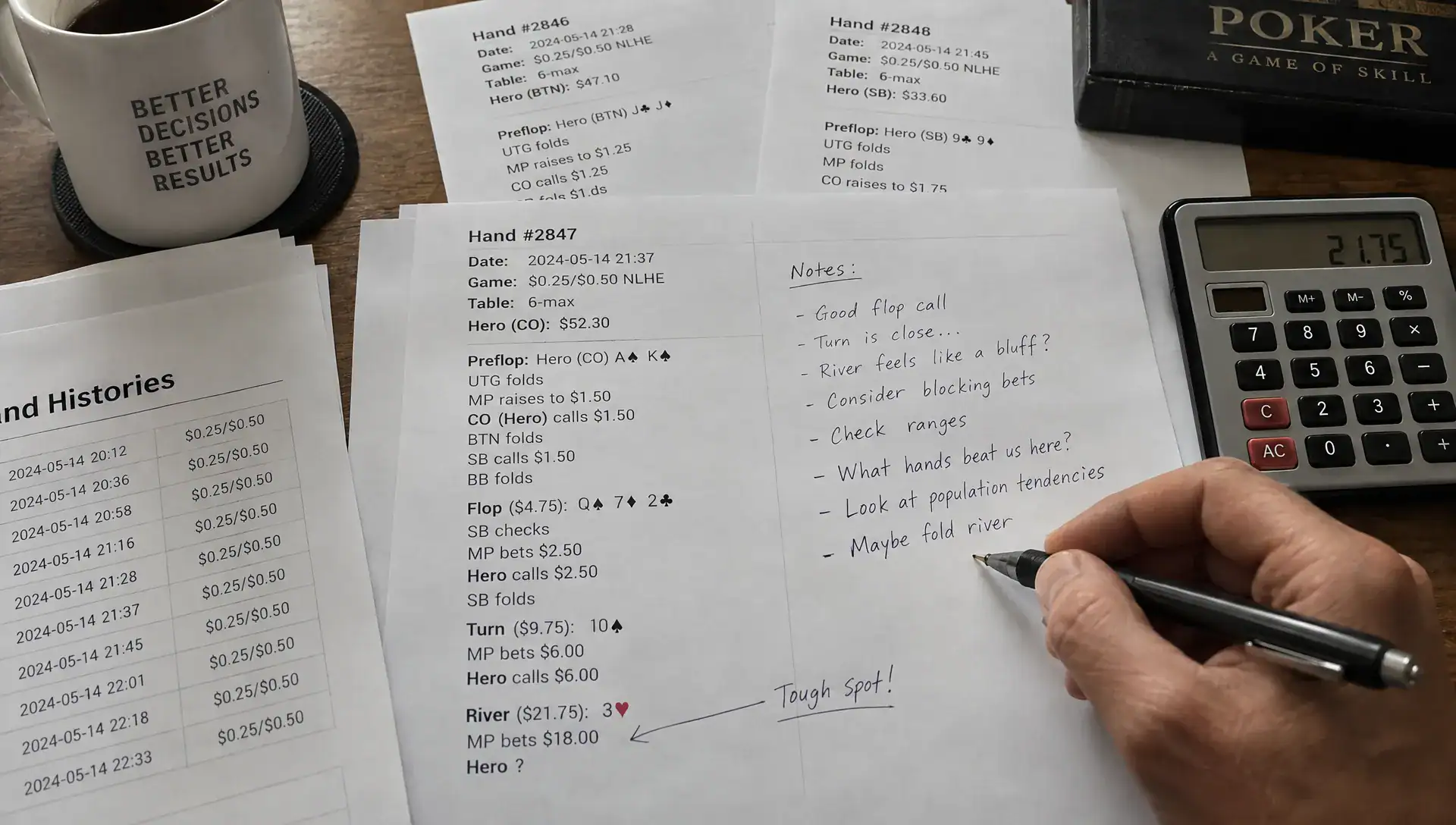
A replayer can make a losing hand feel obvious once the opponent’s cards are visible. Good review reverses that process: hide the result initially, identify the decision and write down the information you actually had.
The best poker apps support this work by keeping relevant context accessible. For cash games, that includes effective stacks and the betting sequence. For tournaments, you may also need payout information, remaining field size and other context that a single hand file does not contain.
Record your position, the action faced, the effective stack and the question you want answered. “Was my river call justified against this range?” is more useful than “How did I lose this pot?” Review the decision before revealing the outcome, then compare your assumptions with the available evidence.
Check pot odds and ranges independently
Suppose the pot is $10 on the river and your opponent bets $5. Calling costs $5 to contest a final pot of $20, so the simple break-even equity threshold is 25% before rake and any relevant adjustments.
That calculation does not tell you whether the call is correct. You still need a plausible betting range and an estimate of how often your hand wins or ties against it. An app that displays the pot clearly helps, but the displayed result cannot replace range analysis.
Similarly, an all-in adjusted result is not a complete measure of skill or luck. Its interpretation depends on the calculation method and available cards. It does not resolve whether you selected the right range, chose a good bet size or avoided an expensive mistake earlier in the hand.
Turn reviewed hands into searchable lessons
When comparing the best poker apps for sustained improvement, prioritize a workflow you can repeat. Use a small set of review categories, whether the software supports tags or you maintain a separate notebook.
Examples include defending the big blind, responding to three-bets and facing river raises. After reviewing several comparable hands, write one specific adjustment to investigate. Do not rewrite your strategy because one opponent showed an unexpected bluff or because a short sample ran badly.
Check how rake and rewards enter the results
Hand histories can help you evaluate the cost of playing, but only if you understand what each number represents. Net winnings, gross pot size, rake attributed to you and rewards credited elsewhere are different measurements.
A tracker may display results after pot rake without including cashback paid later. Conversely, an operator’s performance view may apply adjustments that your imported database does not reproduce. Read the definitions before comparing figures across systems.
For rewards-conscious players, the best poker apps make it possible to reconcile playing results with actual charges and credits. That does not mean the highest advertised rakeback percentage produces the best outcome. Eligibility, contribution methods, reward caps and the games you play all affect what you receive.
Keep these records separate:
- Playing profit or loss over the selected period.
- Rake or tournament fees, using the operator’s stated calculation method.
- Cashback, bonuses or other rewards actually credited.
- Deposits, withdrawals and currency-conversion adjustments.
Deposits are not winnings, and withdrawals are not losses. Keeping transfers separate prevents a common accounting mistake. For tournaments, also check how entries, re-entries, bounties and payouts are represented before trusting an automatically generated return figure.
Avoid double counting rake when building your own spreadsheet. If your playing result is already net of rake, subtracting the same rake again understates performance.
Protect your histories and understand anonymous games
Hand histories may contain screen names, timestamps, stakes and account-related details. Before sharing a hand publicly, remove unnecessary identifiers and check the room’s rules on publishing or distributing records. Do not upload an entire archive to an unfamiliar analysis service just to inspect one decision.
Anonymous tables introduce another limitation. If identifiers change between tables or sessions, you cannot safely assume that the same label represents the same opponent. Your database should not manufacture a long-term player profile from temporary names.
The best poker apps for anonymous games may therefore be those that support reliable self-review rather than persistent opponent tracking. You can still study your own opening ranges, bet sizing and responses to aggression without identifying other players across sessions.
Avoid purchased or shared hand databases, and do not collect hands from games you did not participate in unless the operator explicitly permits the activity. Convenient access is not evidence of permission. Store your own permitted exports securely and retain a backup if they matter to your study routine.
Make the final choice with a simple scorecard
Treat legal eligibility and policy compliance as pass-or-fail requirements. After that, score each candidate against your actual workflow rather than adding up every feature advertised on its website.
A practical scorecard can cover history completeness, retrieval, export usability, replay clarity and cost reconciliation. Give each category a simple rating such as unavailable, workable or strong, and attach a short piece of evidence: a sample file, a successful import or a support response.
Your shortlist of the best poker apps should reflect those results, not a bonus headline. A mobile player reviewing three difficult hands each evening may reasonably prefer a good native replayer. A cash-game player studying thousands of personal hands may need a permitted export-and-database workflow instead.
Treat affiliate offers and promotional links as commercial context, not proof of review quality. This guide does not claim hands-on testing of the listed clients or current verification of their regional features. Confirm the details that matter before depositing or purchasing study software.
Frequently asked questions
Can I review mobile poker hands on a computer? Sometimes. The room must provide a permitted way to access those mobile hands through an archive, account request, desktop client or export. Confirm that mobile sessions are included rather than assuming desktop history settings capture them.
Do I need a tracker to review hands effectively? No. A complete native replayer plus structured notes can support useful decision review. Trackers become more valuable when you need searchable samples, filters or aggregate statistics from your own permitted hand histories.
Are the best poker apps always compatible with third-party software? No. A room can offer useful native review while restricting external trackers or HUDs. Compatibility and permission are separate questions, and both can change. Check the operator’s policy and the analysis tool’s current support documentation.
Can free-play hands test the review workflow? They can test navigation, replay and export when those features match the real-money client. They are less reliable for evaluating opponent behavior, actual rake or tournament economics. Confirm any differences before treating a free-play test as conclusive.
Can AI analyze my hand histories? It can help organize completed hands or explain concepts, but it can also misread action, calculate incorrectly or invent strategic certainty. Verify its work independently, protect personal data and follow the room’s restrictions. Never use it for live decision assistance.
Compare the room after checking the review workflow
Once an app passes your eligibility, policy and sample-history checks, compare its broader offer. Rakeback Bible’s poker room reviews provide a starting point for assessing games, rewards and platform features. Choose a room that fits both your playing budget and your study routine, rather than sacrificing usable hand records for a promotion you may not fully unlock.
