
How Poker Bonuses Affect Your Rakeback Payments


A deposit match can look generous until your next rakeback payment arrives. Some poker bonuses sit alongside cashback without reducing it. Others lower the rake used to calculate your payment, replace another reward or create an adjustment in a later payout cycle. The advertised bonus percentage alone tells you little about the cash you will receive.
The key distinction is whether the bonus reduces your rakeback calculation base, offsets your payment directly or has no effect on it. Those mechanisms produce different outcomes, even when the headline offers look identical.
This guide explains the accounting, shows how to estimate your combined return and gives you a way to investigate an unexpectedly small payment. Every numerical example below is hypothetical, not a statement of any poker room’s current terms. The aim is to compare rewards at your normal playing volume, not to justify depositing more or chasing a deadline.
How poker bonuses change the rakeback calculation
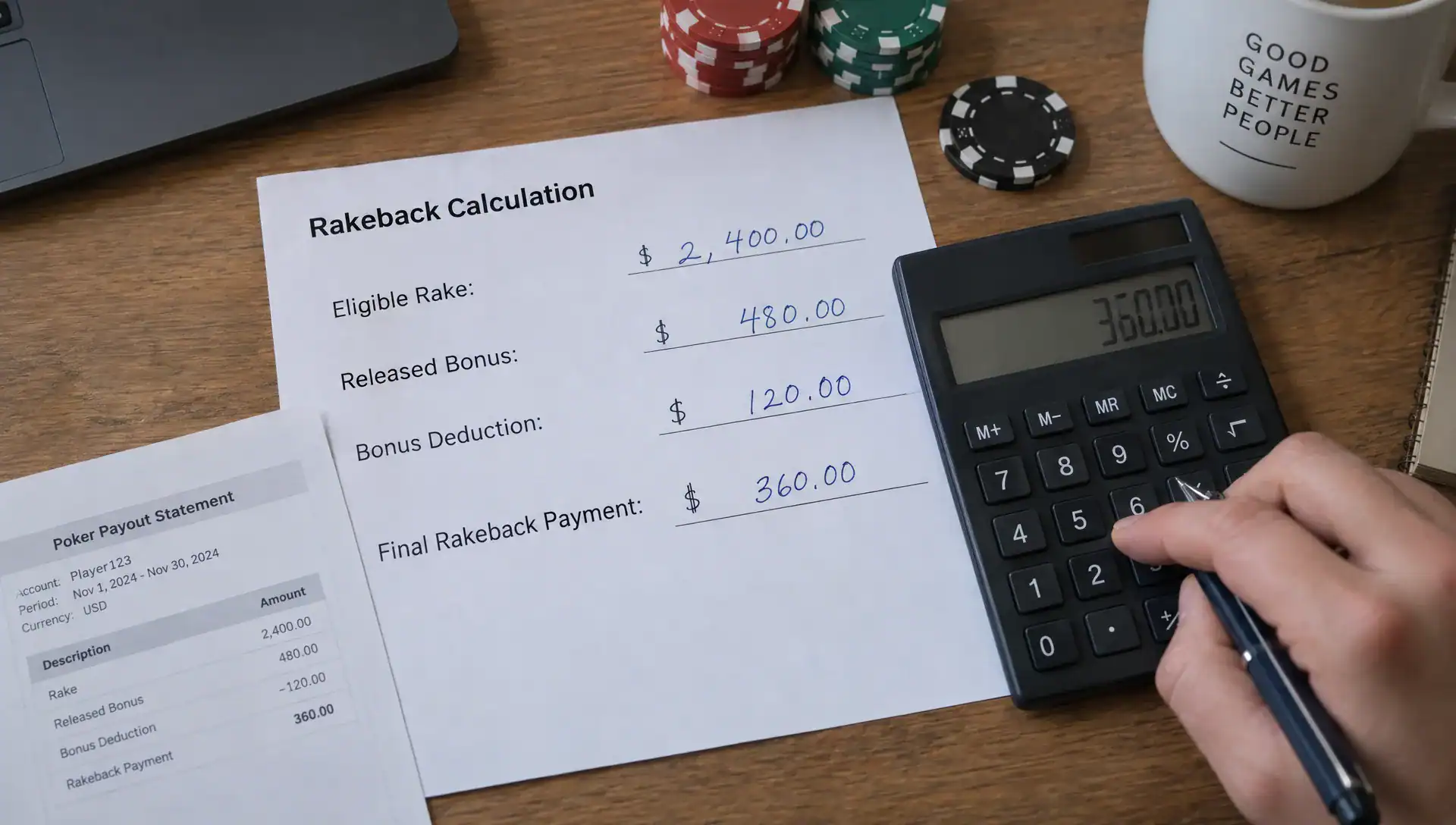
Start by separating three figures: your eligible rake, your rakeback payment and your released bonus. A room can display all three in different parts of your account, and they may cover different dates.
Suppose you generate $1,000 in eligible rake, qualify for 30% rakeback and release a $200 cash bonus. Here is how three possible arrangements compare:
| Promotional treatment | Rakeback calculation | Rakeback paid | Bonus received | Combined cash rewards |
|---|---|---|---|---|
| Bonus does not reduce rakeback | $1,000 × 30% | $300 | $200 | $500 |
| Bonus is deducted from eligible rake | ($1,000 – $200) × 30% | $240 | $200 | $440 |
| Bonus offsets rakeback dollar for dollar | ($1,000 × 30%) – $200 | $100 | $200 | $300 |
These examples assume the bonus is released, usable as cash and subject to no remaining withdrawal restrictions. They also assume no other adjustments.
In the second arrangement, receiving a $200 bonus costs you $60 in rakeback. Your incremental reward is therefore $140, not $200. In the third arrangement, the bonus changes the payment label or timing but adds no combined cash value under these assumptions.
A statement that an offer “stacks with rakeback” does not, by itself, distinguish these outcomes.
Start with eligible rake, not the rake collected at your table
To understand how poker bonuses affect your account, first establish what the operator counts as your rake contribution. The total rake removed from a pot is not automatically the amount credited to you.
Under a weighted-contributed method, attribution generally reflects your contribution to the pot. Under a dealt method, allocation generally depends on being dealt into the hand. Exact implementation and eligibility rules vary, so your hand histories may not reproduce the rewards ledger without further information.
Tournament accounting needs the same care. In a hypothetical event priced as a $20 prize-pool contribution plus a $2 fee, the potentially eligible amount is the $2 fee, not the full $22 entry. The room may exclude particular formats or promotional entries.
Next, identify any deductions between attributed rake and the reward calculation base. Terms may call this base monthly gross revenue, net gaming revenue, net rake or another name. Those labels are not standardized across operators or affiliate agreements. Ask for the definition rather than assuming the acronym explains the calculation.
If the room already reports rake after bonus deductions, do not subtract the bonus again. Double-counting a deduction can make a correctly calculated payment appear too small. Keep the original attributed-rake figure and the adjusted base in separate columns whenever both are available.
Work through a complete payout example
A useful calculation compares the same play with and without the promotion. Keep stakes, eligible volume and the rakeback rate unchanged so that the bonus is the only moving part.
Assume poker bonuses are deducted from the calculation base, and your figures are:
- Eligible rake before promotional deductions: $1,000.
- Rakeback rate: 30%.
- Released cash bonus deducted from that base: $200.
- Other adjustments: none.
Without the promotion, your rakeback would be $300. With it, the adjusted base is $800, producing $240 in rakeback. Add the $200 released bonus and your combined cash reward is $440.
The general calculation is:
Combined cash rewards = rakeback rate × (eligible rake – applicable deductions) + released cash bonus.
When the only deduction equals the released bonus, the incremental reward simplifies to:
Incremental reward = released bonus × (1 – rakeback rate).
Here, $200 × 70% equals $140. Your combined reward represents 44% of the original $1,000 in eligible rake, rather than the 50% suggested by simply adding $300 and $200.
This is a reward calculation, not poker profit. It excludes table results and any separate payment charges. Your deposited money is also not a reward. If rates vary by tier or game, calculate each portion separately instead of applying one percentage to everything.
What if the adjustment arrives in a later cycle?
Payment timing can obscure an otherwise straightforward calculation. A weekly rakeback payment might be processed before a bonus release is reflected in the adjustment ledger.
For example, the account could initially receive $300 in rakeback and a $200 bonus, followed by a $60 rakeback adjustment in the next cycle. Across both cycles, the combined reward is still $440.
When reconciling poker bonuses, match the period in which each reward was earned with the period in which its deduction was booked. Comparing a calendar-month bonus total with four weekly payments can miss an adjustment near the boundary.
Do not assume that a negative calculation base is automatically reset to zero. An agreement might apply a floor, carry a balance forward or settle deductions through another mechanism. That treatment must come from the applicable terms.
Keep separate records for rewards earned, rewards credited and cash withdrawn. A delayed credit is not necessarily a lost reward, but a projected amount should not be treated as money already available. If support confirms a later adjustment, ask which payout period will contain it and retain that explanation.
Estimate the bonus you will actually release
The advertised maximum is rarely the right input for your personal calculation. Use the amount your normal eligible play is likely to unlock before expiration.
Some poker bonuses release in fixed chunks after you earn qualifying points. Others use a rake threshold or another progress measure. Check whether the points used for clearing have the same earning rules as your loyalty points; identical-looking balances can serve different purposes.
Consider an illustrative offer that releases $5 for every 500 qualifying points. If you expect to earn 18,000 eligible points before the deadline, you would unlock 36 chunks, or $180, provided the offer cap is at least that amount.
Whole-chunk rules matter. Earning 18,400 points would still release $180 if partial chunks have no value when the offer expires. A displayed progress balance is not necessarily a cash entitlement.
Then apply the rakeback interaction to the projected $180, not the headline maximum. At a 30% rakeback rate, a full $180 deduction from the calculation base would reduce rakeback by $54, leaving $126 in incremental cash rewards.
Also verify when the clearing clock starts: registration, activation, deposit or another event. Check the expiration time zone and whether play must be completed or processed before the cutoff. These details can determine whether the final chunk releases.
Test the offer at your normal volume
Build the estimate from a representative playing period, not your busiest week. Use completed sessions, eligible tournament fees or recorded qualifying points, allowing for holidays and other breaks.
A practical way to evaluate poker bonuses is to model a conservative case alongside your expected case. If the offer only looks attractive when you maintain unusually high volume, its headline value is not a reliable guide to your likely return.
Rakeback Bible’s guide to using a rakeback calculator to estimate net rewards explains how to organize eligible rake and volume assumptions. For this decision, keep the bonus deduction as a separate input so its effect remains visible.
Repeat the calculation with no bonus, your realistically cleared bonus and the maximum available bonus. The difference between the first two cases is the useful estimate. The maximum case is a ceiling, not a forecast.
If you cannot estimate qualifying volume from existing records, treat the reward projection as uncertain. Do not resolve that uncertainty by depositing more or moving to higher stakes. A smaller bonus released through ordinary play can be preferable to a larger offer that changes your risk or schedule.
Check which rewards really stack
A welcome offer may coexist with cashback, loyalty points, missions, leaderboards and tournament tickets. Coexistence does not mean every displayed value can be added together at face value.
First, check whether activating one promotion makes you ineligible for another. Next, check whether the same play contributes to both. Finally, establish whether receiving or redeeming one reward creates a deduction elsewhere.
Points require particular attention. Spending loyalty points on a bonus might consume value you could otherwise redeem for cash. Counting the purchased bonus and the original points balance would count the same benefit twice.
Tickets need a separate valuation. A $50 tournament ticket is not automatically equivalent to $50 withdrawable cash: its usefulness depends on entry restrictions, expiration and whether you would otherwise play that event. Keep it outside the cash subtotal unless a conservative personal valuation is clearly labeled.
The interaction between poker bonuses and VIP status also matters. A higher tier might change future earning rates, but that benefit is not the same as an already credited payment. Record guaranteed cash, conditional rewards and estimated future benefits separately.
Avoid adding a room’s advertised maximum reward percentage to an affiliate rate unless the terms explicitly permit that calculation. Both figures may already include overlapping components.
Verify the terms before your next deposit
Save the promotion’s terms and the rakeback agreement before activating an offer. Record the date, qualifying deposit, required code, clearing deadline and any written explanation of reward deductions.
For poker bonuses, ask support a precise question: “Does each dollar released reduce my rakeback calculation base, reduce my rakeback payment directly or leave both unchanged?” Then ask whether the answer applies to your account, registration route, location and game format.
If a code or promotion fails to appear, avoid making another deposit to test it. Contact support with the offer details and transaction reference before playing further to clear it. Ask whether the promotion can be applied and whether any existing play would qualify.
For a broader pre-deposit checklist, Rakeback Bible’s guide to evaluating an online poker deposit bonus covers eligibility, release requirements and withdrawal conditions. Here, the additional task is obtaining the exact connection between the bonus and your rakeback ledger.
US players should verify legal availability independently. A state-regulated poker room, a sweepstakes platform and an offshore operator are not interchangeable regulatory categories. Promotional availability does not establish authorization in your state. Consult the relevant state regulator, such as the New Jersey Division of Gaming Enforcement, when checking a room’s status.
Audit a lower-than-expected payment
When a payment seems wrong, reconstruct the calculation before comparing it with the advertised rate. The problem might be a deduction, an eligibility difference or a mismatch between reporting dates.
For an audit involving poker bonuses, collect the following records:
- The exact payout period and the date each payment was credited.
- Eligible attributed rake or fees before promotional adjustments, if available.
- The rate, tier or reward formula applicable during that period.
- Released bonuses and other itemized deductions.
- Previous balances, reversals and any carried-forward adjustments.
Calculate the expected payment using those inputs. If it differs from the credit, ask support to identify the missing line item rather than requesting a general explanation of the rewards program.
A useful message is: “For this payout period, my statement shows $1,000 in eligible rake, a $200 bonus deduction and a 30% rate. I calculate $240 in rakeback, but received $210. Please provide the remaining adjustment and its applicable term.”
That question makes the unresolved $30 explicit. It also leaves room for a legitimate additional adjustment without assuming one exists.
Retain screenshots or exported statements and the support response. If the original report contains only an already-adjusted figure, ask for the reconciliation from attributed rake to the final calculation base. That bridge is often more useful than another copy of the final payment total.
Compare total value without increasing your risk
Two offers should be compared at the same realistic volume and over the same period. A short clearing window should not be evaluated against an entire year of projected rakeback.
The value of poker bonuses depends on what you would receive without them. A $150 incremental reward can be better than a nominal $300 bonus that replaces $300 of existing cashback. Equally, a high combined reward percentage can be less attractive if the underlying rake is higher.
Where comparable data are available, estimate the remaining rake cost after cash rewards. For $1,000 in attributed rake and $440 in combined cash rewards, that cost is $560. This remains separate from wins and losses at the tables, and differences in game conditions still matter.
Include relevant deposit, withdrawal or currency-conversion charges when comparing the cash you expect to retain. Do not add speculative leaderboard prizes or unused tickets as guaranteed cash.
Most importantly, do not increase stakes or extend sessions solely to recover an expiring reward. Additional play brings additional rake and possible losses; a bonus does not make those costs disappear. If promotional deadlines are affecting your spending or ability to stop, pause the offer. The National Council on Problem Gambling provides information about support and treatment resources.
Frequently asked questions
Does a deposit bonus reduce rakeback by its full amount? Not necessarily. If a $100 bonus is deducted from the calculation base at a 30% rakeback rate, rakeback falls by $30. A direct dollar-for-dollar payment offset would instead reduce it by $100, assuming sufficient rakeback is available. The agreement determines which treatment applies.
Can I receive poker bonuses and rakeback together? Sometimes. Confirm whether both rewards accrue from the same play, whether either reduces the other and whether your account qualifies for the combination. Receiving two separate credits does not prove that the bonus added its full face value to your overall return.
Does an uncleared bonus reduce my payment? Do not assume that the entire advertised amount is deducted. Check whether adjustments occur when the offer is activated, as bonus chunks release or at another defined event. The trigger and the amount should be identifiable in the terms or account ledger.
Why did my rakeback fall after the bonus finished? A deduction may have been processed after the bonus credit, but other explanations include tier changes, excluded play or earlier adjustments. Reconcile the earning periods and request an itemized calculation before attributing the difference to the promotion.
Should I decline a bonus that reduces rakeback? Not automatically. A calculation-base deduction can still leave positive incremental value. Compare the combined cash reward with the no-bonus alternative at your normal volume, then consider expiration, withdrawal restrictions and any rewards you would give up.
Compare offers using the cash you expect to keep
Before claiming an offer, establish three things: how much you can realistically release, how that release changes rakeback and when the final adjustment will appear.
You can compare the listed poker bonuses and cashback offers in Rakeback Bible’s poker deal directory, then confirm the current account-specific terms with the room. Choose based on the additional value available through your normal play, not the largest advertised percentage.
