
How Anonymous Tables Work on Bovada Poker

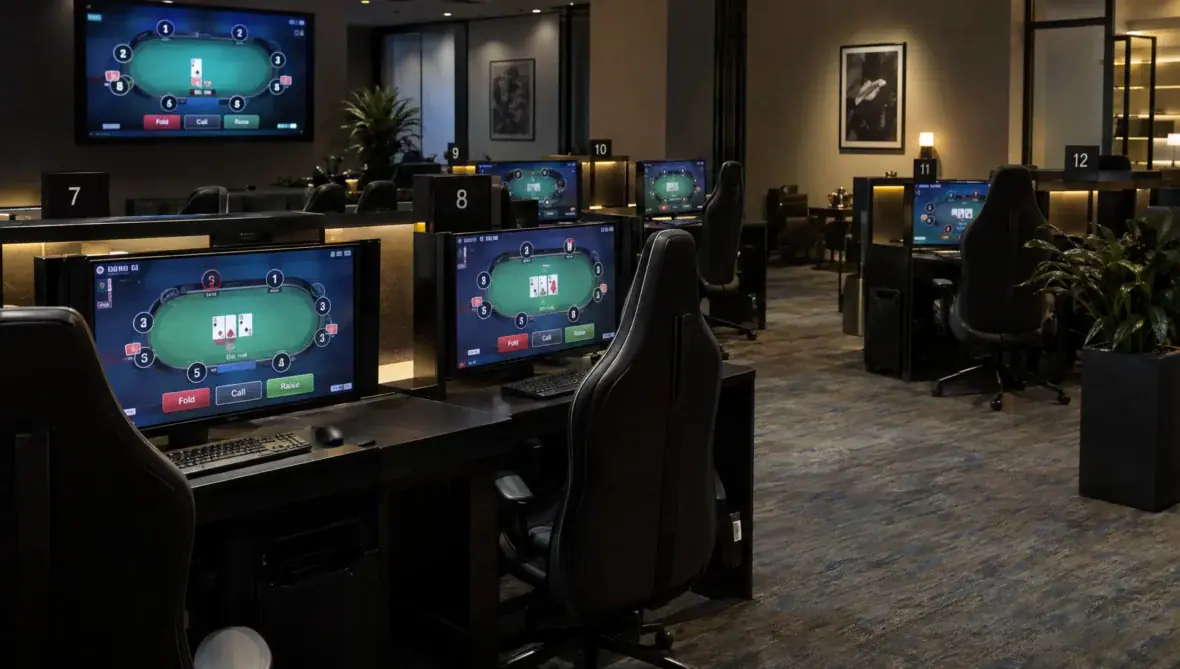
Bovada Poker uses anonymous tables to replace public screen names with numbered player labels. You can still see opponents’ actions, chip stacks and exposed cards, but you do not get a reusable username for building a long-term profile. The practical effect is straightforward: decisions depend more on what happens at your current table and less on recognizing someone from previous sessions.
That changes how you take notes, interpret tracking statistics and review hands. It does not make opponents unreadable or guarantee a fair game.
What other players can and cannot see
Anonymous poker hides a public identity, not the action needed to play the game. Opponents still observe your bet sizes, position, stack depth and decisions. When your cards are exposed at showdown, they can connect those cards to the line you took.
The distinction matters because a numbered opponent can still develop a recognizable pattern during a session.
| Information | What anonymity means |
|---|---|
| Public screen name | Replaced by a numbered player label |
| Stack size and betting actions | Still visible during play |
| Cards exposed at showdown | Still available for opponents to interpret |
| Permanent opponent profile | No ordinary public username to follow across sessions |
| Account and identity records | Not hidden from the operator by table anonymity |
A player who repeatedly limps into pots or uses unusually large river bets is giving away information even without a name. Conversely, recognizing a familiar number is not enough to establish that you have encountered the same person before.
How Bovada Poker anonymity works across formats
The basic idea stays the same across games, but the useful lifespan of a read depends on the format. Do not treat a numbered label as a permanent account identifier or assume its meaning is identical everywhere in the client.
Regular cash tables
At an ordinary cash table, you can observe the same opponents over successive hands. Notes about the player currently occupying a seat can therefore help with later decisions at that table.
If someone leaves and another player arrives, reassess that seat. A seat number identifies a position in the game, not a dependable cross-session identity.
Poker tournaments
Tournament anonymity does not remove the information created by repeated hands against the same opponent. You can still observe opening sizes, blind defense and reactions to short stacks.
Keep those observations tied to the relevant opponent and table context. Do not assume a tournament label is a permanent identity across separate events. Also account for changing incentives: someone playing cautiously near a payout threshold may behave differently after it passes.
Zone Poker
Zone Poker is the fast-fold format, where folding moves you toward another hand with a newly assembled table. This makes extended observation of one opponent less practical than at a regular cash table.
Focus first on position, effective stacks and the action in front of you. A brief encounter provides little basis for a confident player-specific adjustment.
What anonymity means for HUDs and player notes
A traditional heads-up display, or HUD, becomes useful by connecting statistics to the correct opponent. Without persistent public screen names, the familiar model of collecting thousands of hands on a named regular becomes much less useful.
On Bovada Poker, distinguish between what software can technically display and what the room currently permits. Anonymous tables do not, by themselves, answer whether a particular HUD, hand grabber, importer or overlay is allowed.
Check the current prohibited-software rules before using any third-party tool. The existence of a commercial product is not evidence that the operator approves it.
For your own session notes, record observations rather than labels such as “bad player.” A useful note might say: “Called a large river bet with a weak one-pair hand after checking twice.” That describes an action and its context without pretending it proves a permanent tendency.
Sample size remains a limitation. One loose call does not establish that someone always calls too much, and a few folds do not prove that they are easy to bluff. Keep a distinction between an observed hand, a tentative read and a pattern supported by repeated evidence.
How to adjust your decisions at anonymous tables
Start with the situation, then add reads
Build your initial decision around position, effective stack size, previous action and board texture. These remain available even when you know nothing about the opponent.
For example, suppose an unidentified player opens from early position and you hold a marginal hand on the button. The absence of a username is not a reason to assume the opener is reckless. Begin with a reasonable range for that position, then adjust if their actions provide evidence.
A sound starting strategy matters on Bovada Poker because you will often make decisions before collecting meaningful individual reads.
Make observations specific enough to test
Compare “this player is aggressive” with “this player has raised three late-position opportunities and shown down one weak suited hand.” The second observation gives you something concrete to evaluate.
Even then, use measured adjustments. A small sample might justify watching more closely, but not a dramatic departure from your usual strategy. Stack depth and table position can explain behavior that initially looks like a personal tendency.
Avoid treating timing as proof of hand strength. A pause might reflect a difficult decision, a connection issue or activity at another table.
Select games without chasing identities
Anonymous tables shift attention toward the game itself. Look at stakes, stack depths, available seats and the action you can legitimately observe rather than trying to locate a particular person.
Rakeback Bible’s guide to choosing an easier poker table explains selection principles, though you should use only the lobby information and observation options the current client actually provides.
A promising table is not automatically profitable. Rake, your own skill and the size of the available sample still affect the decision to play.
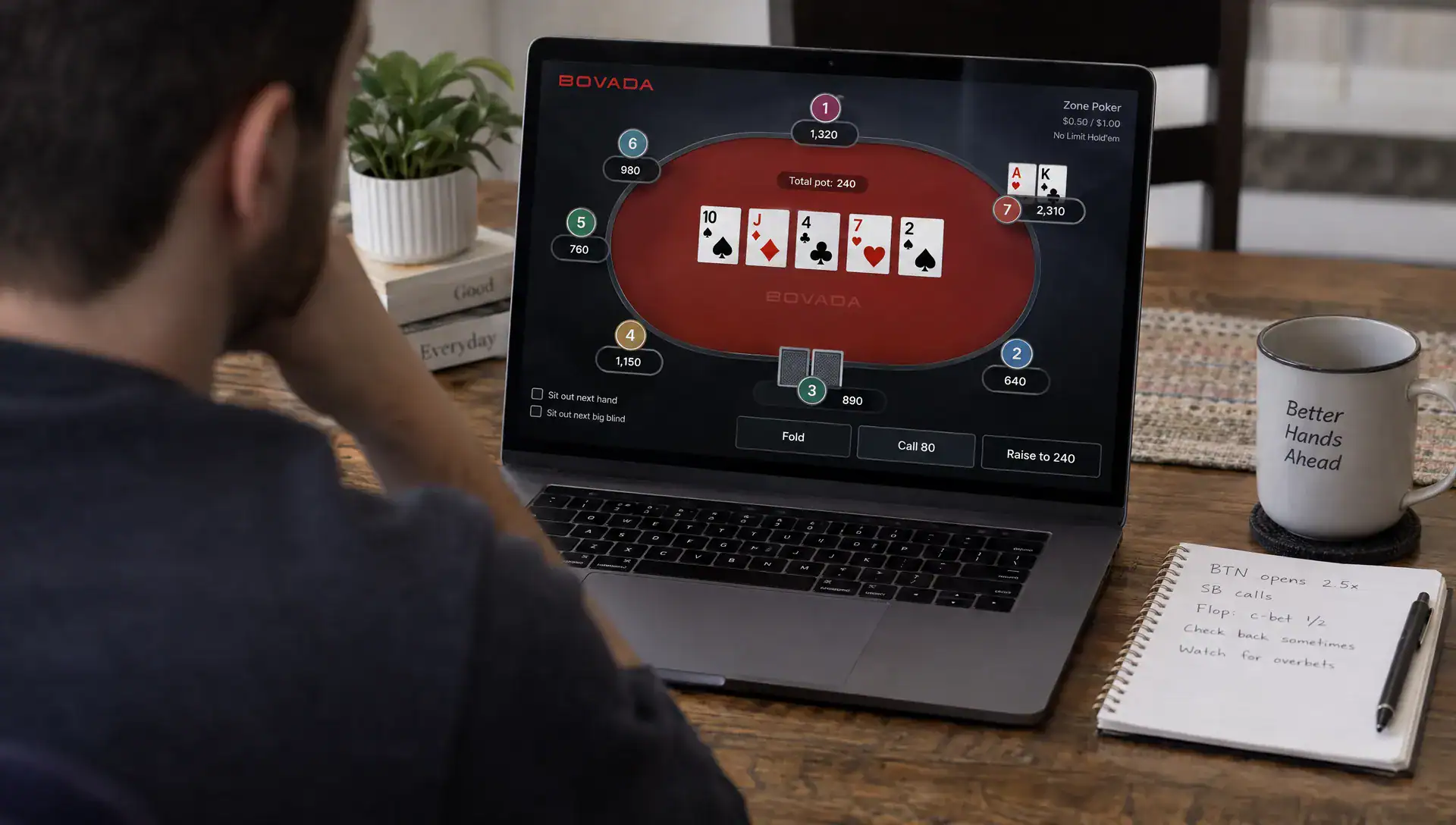
Reviewing hands after the session
Anonymity makes disciplined hand review more valuable because memory alone is unreliable. Save the hand reference and your reasoning when a decision feels uncertain, rather than recording only whether you won or lost.
Bovada has offered downloadable hand histories that reveal opponents’ hole cards after a 24-hour delay. Confirm the current availability, release timing and retrieval window in the client or official help materials, since these details can change. Do not confuse delayed review information with cards available during live play.
When reviewing Bovada Poker hands, first assess your decision using only the information you had at the time. Then examine any additional cards the history provides. Otherwise, knowing the result can make a reasonable fold look foolish or a poor call look justified.
Useful review questions include whether your estimated range was sensible, whether your bet size served its intended purpose and how a different stack depth would have changed the hand.
Keep conclusions proportionate to the evidence. A group of reviewed hands may suggest a tendency in your games, but it does not establish how every anonymous opponent plays. Population reads are working assumptions to test, not substitutes for paying attention.
Anonymity is not the same as security or fairness
Numbered labels reduce ordinary player-to-player identification. They do not make your account anonymous to the operator, remove identity-verification obligations or prove that collusion and prohibited software are absent.
Those are separate issues. The operator has access to account and gameplay records that ordinary players cannot see, but the anonymous interface alone tells you little about the effectiveness of its enforcement.
If something appears suspicious, preserve hand references, table details and approximate times, then report the behavior through the official support channel. Repeated unusual actions deserve examination; a single surprising hand is not proof of cheating.
Before funding a Bovada Poker account, verify the operator’s address independently, check eligibility for your location and review withdrawal and identity-check requirements. A padlock icon indicates an encrypted connection, not that a website is legitimate or locally authorized.
The same checks apply to other rooms. Our guide to evaluating a poker site before sharing your ID covers the privacy and verification questions worth asking before sending documents. Do not use location-masking tools to bypass restrictions.
Set limits before joining a table
Anonymous opponents can make a session feel less personal, but they do not reduce financial risk. Decide your affordable spending limit and finish time before playing, and do not increase either to recover losses. Use available deposit limits, time-outs or self-exclusion tools when needed.
Plan screen-free breaks as well. A walk requires no purchase; if you prefer exercising at home, home-training equipment can support a separate routine away from the table. Breaks are not a way to make continued gambling safe, and stopping is the appropriate choice when play becomes stressful or difficult to control.
Frequently asked questions
Can other players recognize me at an anonymous table? They do not receive a persistent public username, but they can observe your behavior while playing against you. Unusual bet sizes or repeated patterns can create useful in-session reads.
Does my player number identify me permanently? Do not treat a numbered label as a permanent account identity. Its context depends on the game format, and matching numbers alone are not reliable evidence that two encounters involved the same person.
Can I use a HUD on Bovada Poker? Check the current rules for the exact software and its functions before using it. Technical compatibility does not establish permission, and anonymity limits the usefulness of conventional named-player databases.
Does anonymity stop collusion? No. It changes what players can see about one another, but it is not a substitute for game-integrity monitoring. Report specific suspicious hands rather than assuming numbered tables guarantee fairness.
Are anonymous tables easier to beat? Not inherently. Results still depend on opponents, rake, game structure, variance and your decisions. Anonymity removes some information advantages without guaranteeing that the remaining game favors you.
Decide whether the format suits your approach
Anonymous tables suit players willing to build reads from current action rather than rely on familiar names. Before choosing a room, compare that trade-off with game availability, costs, eligibility and withdrawal terms. Rakeback Bible’s Bovada room review provides the broader context beyond the anonymous-table format.
