
How to Keep Your Poker Money Separate From Everyday Spending

Keeping your poker money separate from everyday spending starts with a firm rule: money needed for rent, groceries, debt payments or emergencies never enters the game. A dedicated account helps, but it only works when deposits, withdrawals and rewards follow rules you set before playing.
You do not need complicated accounting software. You need a clearly defined bankroll, somewhere to keep it and a record that distinguishes playing results from transfers. The goal is not to make poker profitable. It is to keep a losing session from becoming a household financial problem.
Set the boundary before opening an account
Your bankroll is the amount you have deliberately allocated to poker and can afford to lose without missing obligations. It is not your available credit, your emergency fund or the balance left in checking before bills arrive.
Start with your household budget. Cover essential spending, debt obligations and planned savings first. If there is no genuinely discretionary money left, the appropriate poker budget is zero. Free games remain an option without putting household funds at risk.
Write down two separate limits: your initial bankroll and the maximum additional amount, if any, you can contribute during a defined period. A one-time allocation of $200 means something different from permission to deposit $200 whenever the balance runs out.
Treat poker money as a limited entertainment allocation, not an income source you need to make the budget work. If someone shares your finances, agree on that boundary together rather than relying on an account they cannot see.
Give your bankroll a separate home
A dedicated checking account, a bank subaccount or a clearly labeled savings pocket can make the boundary visible. Check fees, minimum balances and whether the account permits your intended transactions. Not every bank or payment provider supports gambling-related payments.
Keep your regular paycheck and household autopayments in your everyday account. Transfer only the agreed poker allocation into the dedicated account, then use that account for permitted deposits and withdrawals. Where available, a separate debit card can reduce accidental mixing.
If another account would create unnecessary fees, use a separate budget category with its own ledger instead. This requires more discipline because the bank balance still contains money assigned to different purposes. A spreadsheet category does not stop you from spending the same dollars twice.
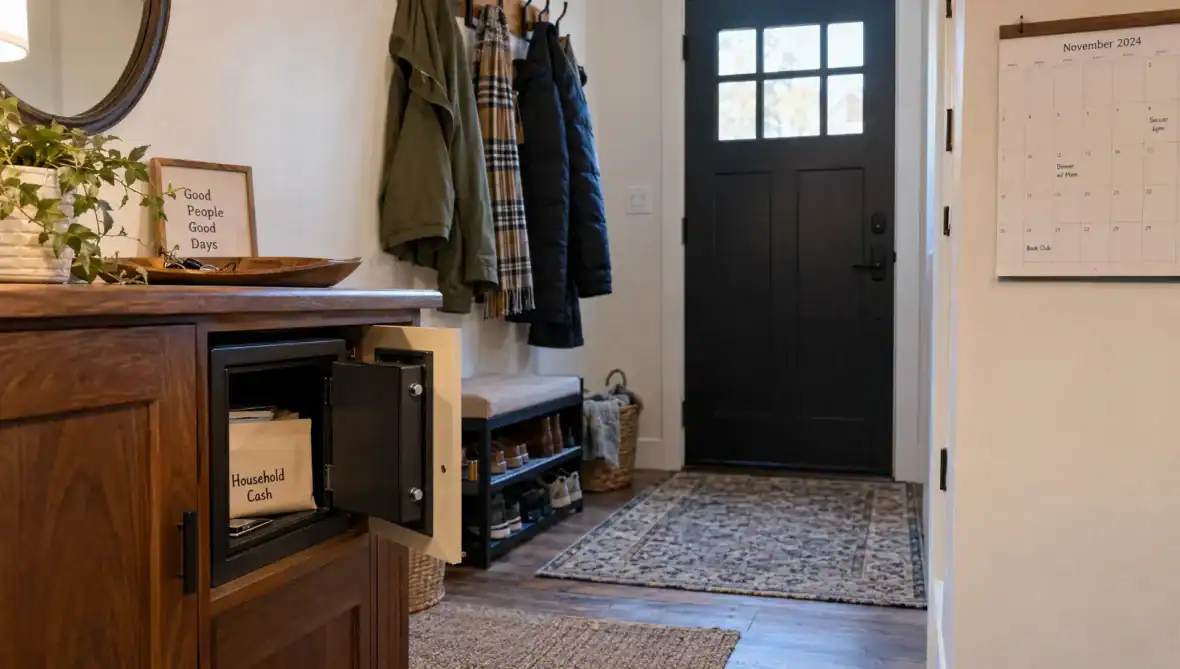
For live play, designate a cash envelope or secure cash reserve and record every movement in and out. Cash withdrawn for a session remains part of your poker money until it is spent, lost or deliberately reassigned. Taking it out of an ATM does not make it an expense by itself.
Do not confuse separation with protection at a poker site
A poker-room balance is not interchangeable with money in your bank account. Withdrawal access, verification requirements and treatment of customer funds depend on the operator and jurisdiction.
Keep only the amount needed for your planned play on a site, allowing for its actual deposit and withdrawal conditions. Check legal availability and minimum-age requirements in your state before funding an account. A room accepting a payment does not establish that you are eligible to play there.
Rakeback Bible's guide to assessing poker-site player fund safety explains the custody and withdrawal questions worth asking before depositing.
Set deposit and withdrawal rules in advance
Decide what authorizes a transfer while you are away from the tables. A useful rule specifies the amount, timing and source of any additional contribution. “I can add $50 on the first of next month if my entertainment budget allows it” is clearer than “I can reload when necessary.”
Use the operator's deposit limits where available, alongside your own budget. Check whether a limit applies to deposits, net deposits or losses because these controls do not necessarily measure the same thing. Do not spread deposits across sites to get around a limit.
Your poker money also needs an exit rule. You might review the balance monthly and withdraw an amount above a preselected bankroll ceiling, after allowing for taxes and other obligations. That ceiling is a budgeting choice, not evidence that your stakes are safe.
Once a withdrawal is reassigned to household spending, remove it from the bankroll ledger. It cannot simultaneously cover groceries and support next week's buy-ins. Likewise, a pending withdrawal should not fund a bill that must be paid before the transfer arrives.
Track poker money without mistaking transfers for profit
The most useful record separates where funds are held from how the balance changed. Moving $100 from your dedicated bank account to a poker room changes the location, not your total bankroll or playing result.
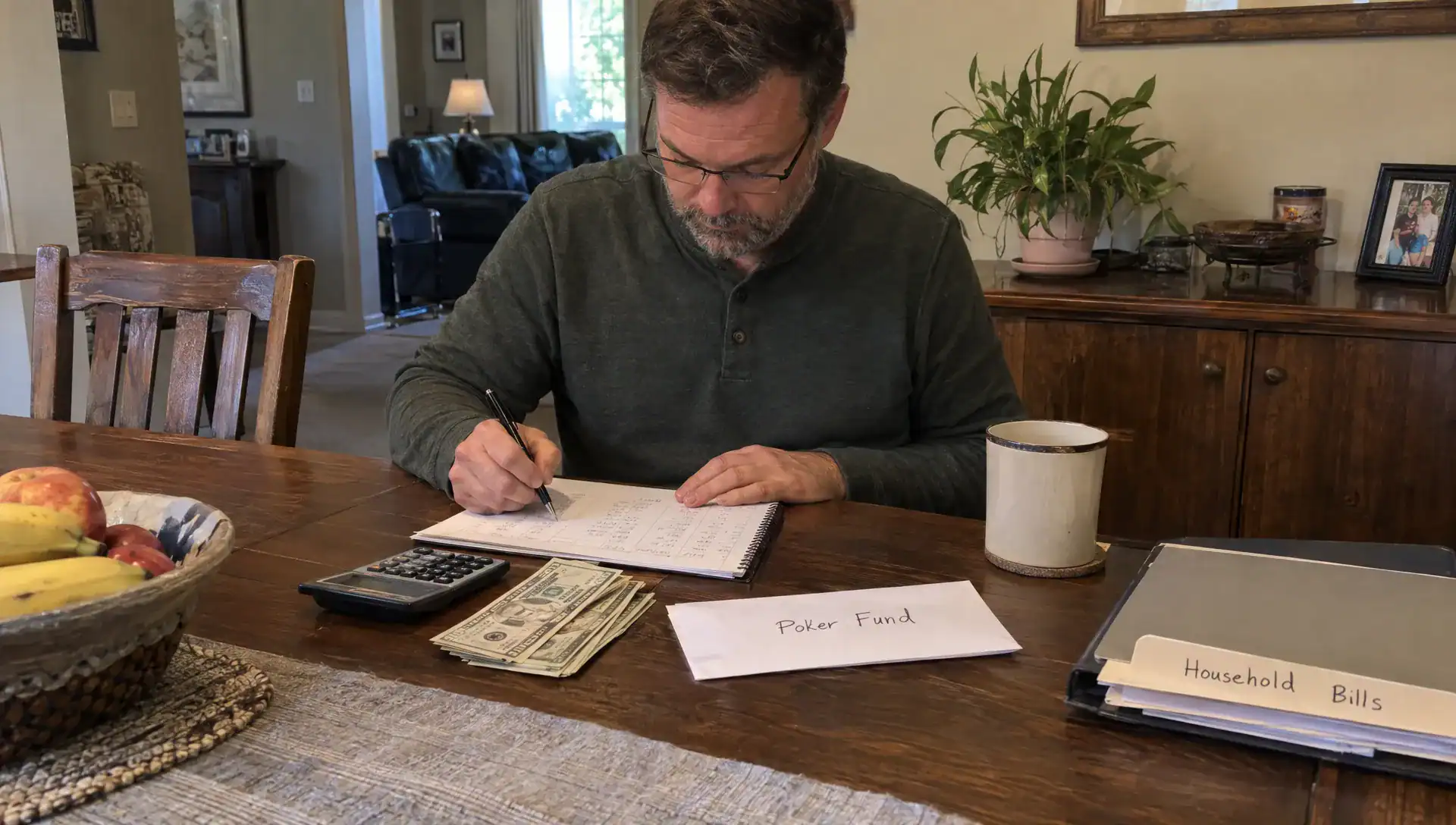
Record the date, amount, transaction type, location and any fee. Save operator statements and session records so you can reconcile entries rather than reconstructing them from memory. For live sessions, count the cash you take and bring home, noting any non-poker spending separately.
At each review, reconcile the ledger against bank balances, operator balances and physical cash. Track pending transfers separately so you do not count money at both the sending and receiving ends. Unreleased bonuses and expected rewards should not appear as available cash.
A worked monthly example
Suppose you begin the month with $600 across your dedicated account, poker-room balance and live-play cash. The following figures are illustrative:
| Entry | Effect on total poker funds |
|---|---|
| Opening balance | $600 |
| New contribution from the agreed entertainment budget | +$100 |
| Playing result after rake and tournament entry fees | -$90 |
| Released cash rewards | +$10 |
| Payment processing fees not already counted | -$5 |
| Withdrawal reassigned to household spending | -$75 |
| Closing balance | $540 |
Here, poker money fell by $85 from playing, rewards and payment fees combined. The $100 contribution was not a win, and the $75 household withdrawal was not an additional playing loss. Those distinctions prevent an increasing account balance from hiding losing play.
Do not subtract rake or tournament fees again if your recorded playing result already includes them. Track travel, software and similar costs separately if you want a fuller picture of what the activity costs you.
The closing $540 is not automatically all available for play. Any tax reserve, money owed to someone else or unpaid poker-related expense needs its own allocation before you decide what remains available to risk.
Put rewards in the correct budget
Rakeback and released bonuses belong in your poker records because they arise from your poker activity. Record them separately from table results so you can see both how you played and how rewards affected the overall balance.
Count rewards only when they have actually been credited and their restrictions are understood. A bonus that requires more wagering is not equivalent to withdrawable cash. Nor does a reward justify playing extra sessions, moving up stakes or spending beyond your original limit.
Compare offers against the volume you already intend to play. Rakeback Bible's guide to choosing poker websites for low-volume players covers why achievable rewards matter more than a headline percentage.
Shopping cashback belongs elsewhere. If you already compare offers on planned household purchases, a service such as Best Cashback's shopping cashback comparison can help you compare available rates. Check eligibility, exclusions and payout terms, and keep those savings in the household budget rather than treating them as permission to deposit more.
The same principle applies to welcome offers and temporary promotions: they can change the final cost of an activity, but they should not determine whether you can afford it. Your poker money limit stays fixed even when an offer looks attractive.
Make downswings trigger limits, not emergency funding
Separation matters most after losses. Decide beforehand what happens when the bankroll reaches a lower threshold: reduce stakes, pause real-money play or stop until a scheduled budget review. None of those decisions requires winning the money back first.
Avoid treating a fixed number of buy-ins as a guarantee. Different formats have different swings, and having enough entries to continue playing says nothing about whether you have a winning edge. No bankroll size turns an unprofitable game into a profitable one.
A session loss limit can restrict spending during that session, but it does not improve the odds of the next hand. Do not restart immediately on another site or redefine a new deposit as a fresh budget.
Borrowing, using money needed for bills or repeatedly breaking your own limits is a reason to stop, not refine the spreadsheet. Use cooling-off or self-exclusion tools and seek support if controlling play becomes difficult. Protecting poker money must never take priority over protecting your finances.
Reserve for taxes and money owed to others
For US players, bank transfers are not a reliable measure of taxable gambling income. The IRS guidance on gambling income and losses explains reporting and recordkeeping requirements. Do not assume that leaving winnings on a site postpones reporting, or that losses automatically cancel winnings dollar for dollar for tax purposes.
Federal and state treatment can differ, and rules can change. Ask a qualified tax professional how your circumstances affect reporting, deductions and any estimated payments. There is no single reserve percentage that fits every player.
Keep relevant statements, session records, receipts and tax forms. A monthly balance summary is useful for budgeting, but it may not contain the detail needed for a tax return.
If you play under a staking or backing arrangement, separately identify funds belonging to others and any contractual obligations. A large cashier balance is not necessarily money you own outright. Exclude amounts owed to backers, agreed expenses and your tax reserve before calculating how much poker money is available for future play or personal withdrawal.
Frequently asked questions
Do I need a separate bank account for poker? Not necessarily. A dedicated account makes separation easier, but a properly maintained budget category can work. Compare account fees and payment restrictions before opening one, and reconcile the records regularly.
Can I pay everyday bills from poker winnings? You can reassign a completed withdrawal after accounting for obligations, but essential bills should not depend on winning or receiving a withdrawal on time. Once reassigned, remove that amount from your bankroll.
Is 20 buy-ins enough? There is no universally safe number. Format, variance, skill and the consequences of losing all matter. More buy-ins do not make a game profitable, and bankroll guidelines never justify using essential funds.
What if my bankroll reaches zero? Stop real-money play. Do not automatically refill it from savings or credit. Any later contribution must fit a previously agreed discretionary budget, and choosing not to replenish your poker money is always valid. You can play poker for fun without spending money instead.
Put the system in place before your next deposit
Choose the maximum amount you can afford to lose, give it a separate home and write down your transfer rules. Then schedule a short monthly reconciliation. When comparing rooms and rewards on Rakeback Bible, start with those boundaries: no promotion should require you to weaken the protections around your everyday spending.
