
Finding the Best Site to Play Poker at Off-Peak Hours
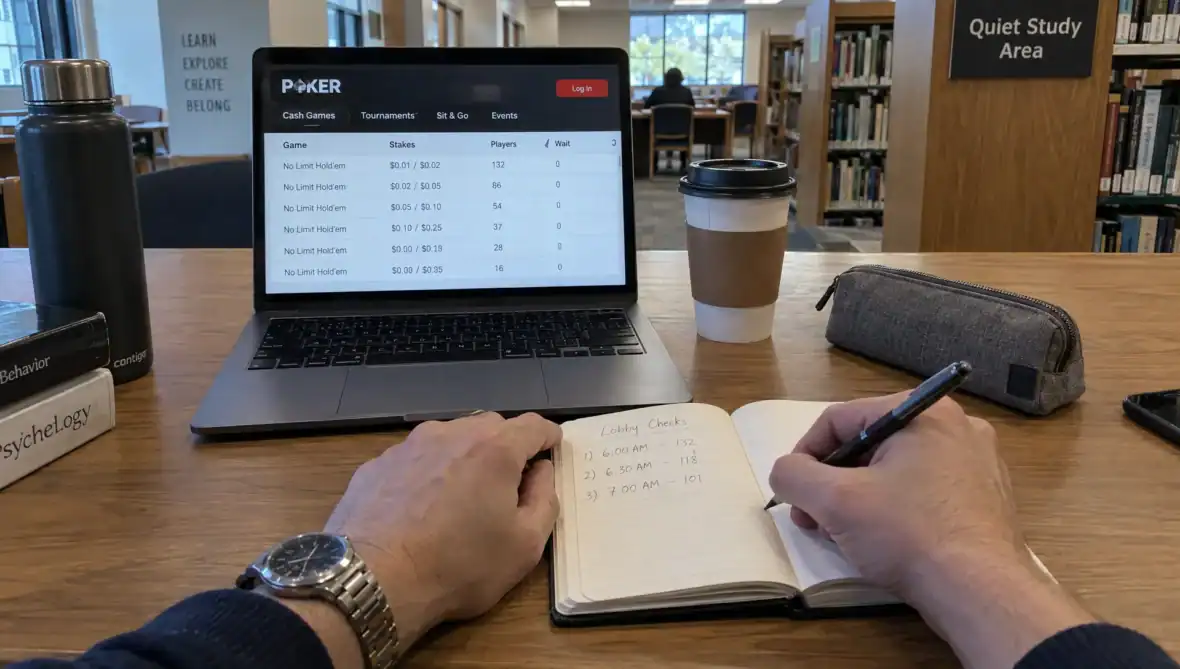
The best site to play poker during off-peak hours is the one that runs your preferred games, at affordable stakes, when you can actually log in. A large advertised player count means little if your lobby has one usable table before breakfast.
Start with legal access, then compare playable seats, waiting times and costs across several matching sessions. This guide provides a testing framework rather than a live traffic ranking. Named operators are examples to investigate, not claims of current availability, guaranteed action or regulatory approval where you live.
Start with your playing window, not a traffic ranking
Off-peak is relative to a player pool, not your wall clock. An early-morning session in the United States can overlap with a different part of the day elsewhere, but that only helps if those players share your tables. Separate regional clients or segregated pools may prevent that overlap entirely.
Write down your usual start time, finish time, local time zone and game. Be specific: “Tuesday and Thursday, 6:00 to 7:00 a.m., Eastern Time, $0.05/$0.10 no-limit hold’em” is testable. “Mornings, low stakes” is not. Note whether work schedules, weekends or daylight saving changes alter the window.
Define the best site to play poker for your schedule
For that window, a room must offer enough choice without pushing you above your planned stakes. A room with strong evening traffic can still be a poor fit at dawn. Conversely, a smaller room may work if its active tables match your exact game.
Check ordinary weekdays and weekends separately. One promotional tournament or a holiday surge should not define your expectations for a routine workday session. Record the time zone used in the client so tournament start times and lobby observations remain comparable. Also decide in advance how long you are willing to wait before abandoning the session.
Apply the legal-access filter before comparing lobbies
Access is a pass-or-fail condition. For US players, distinguish an operator authorized by the relevant state regulator from an offshore room that accepts registrations. Acceptance of a deposit, a foreign license or a successful login does not establish that online poker is lawful or state-regulated where you are.
Use the regulator’s own operator list and the room’s current location rules. The New Jersey Division of Gaming Enforcement is one example of an official starting point, not a nationwide approval service. Rakeback Bible’s state-by-state poker-site guide explains the distinctions to check before comparing offers.
Shared liquidity matters when choosing the best site to play poker after hours. State participation in an interstate arrangement does not mean every operator, game or client version connects to every other state. Confirm the specific pool available through your account and physical location.
After those checks, compare available games. Do not bypass geolocation or eligibility restrictions with a VPN. If no authorized option is available to you, play-money practice may be more appropriate than treating an offshore registration as a legal workaround.
Recheck access when traveling, moving home or changing accounts, because your previous location’s permissions do not travel with you. Ask the operator to identify its licensed entity if the client branding and legal terms do not clearly match.
Shortlist rooms by the pool you can actually access
Build a shortlist by market structure before comparing brands. This avoids treating a global marketing figure as if it described the lobby available to you.
| Candidate category | Examples to investigate | Off-peak question |
|---|---|---|
| State-authorized poker | PokerStars, BetMGM Poker or WSOP-branded rooms, where authorized | Which states and players are connected through this particular client? |
| Internationally licensed poker | GGPoker or PokerStars, where locally permitted | Does the accessible regional pool run your stakes during your window? |
| Offshore or cross-border offers | ACR Poker or CoinPoker | What local legal restrictions, licensing protections and withdrawal conditions apply? |
These are research categories, not interchangeable recommendations. The same brand can operate different products under different rules, and branding alone does not identify your player pool. Verify the operator entity, website and regulator rather than relying on a familiar logo.
Your best site to play poker may therefore be a regional room rather than the biggest global name. Shortlist only two or three eligible options, then test them at identical stakes and times.
Do not deposit at every candidate just to inspect traffic. Use public schedules, permitted lobby access and current support answers first. Some information will remain unavailable until account verification; record that uncertainty instead of filling the gap with assumptions.
Run a repeatable three-session lobby check
Choose three ordinary sessions in the same weekly window, preferably on different days. Compare candidates as close together as practical, because a lobby checked at 5:30 a.m. is not directly comparable with one checked at 8:00 a.m. Save dated notes without collecting other players’ private information.
At each check, record the exact game, stake, occupied tables, empty seats and waiting-list length where visible. Note whether a seat was genuinely available or appeared only after waiting. Recheck partway through your intended session: a table that opens briefly but collapses ten minutes later offers little dependable playing time.
A simple worksheet can use these fields: room, date, local time, pool, format, stake, joinable tables, wait and interruptions. Record observations rather than estimates, and respect the room’s restrictions on data collection or third-party software.
The best site to play poker should emerge from repeated availability, not one attractive screenshot. If a room provides limited lobby detail, use permitted in-client observation and mark unavailable information as unknown. Never turn an unknown into a favorable score just because a promotion looks appealing.
Keep the trial small; you are evaluating access, not trying to generate a large sample of winnings. A losing or winning session alone proves little about room quality.
Measure cash-game choice, not just occupied seats
Six occupied tables do not necessarily mean six usable choices. Your effective pool consists of seats at your chosen stakes, in the correct format, with buy-ins you can afford. Full tables, higher limits and games outside your plan should not inflate the count.
Also distinguish available seats from sustainable action. Repeatedly seeing the same small group across several tables can signal concentrated traffic, although it does not prove anything about skill or conduct. A lobby total cannot tell you whether a particular lineup suits your experience.
When visible, table statistics can add context. Average pot size and players seeing a flop need interpretation across a useful sample; neither establishes that a game is easy. Rakeback Bible’s table-selection guide explains how to read those signals without relying solely on traffic.
The best site to play poker gives you a workable alternative when one table breaks. For a one-hour session, consistently joining one suitable game quickly may matter more than browsing ten tables that are all full.
Set your minimum before testing: for example, one available seat at your regular stake plus another suitable table to move to. This is a personal requirement, not a universal threshold. Do not climb limits merely to satisfy it.
Judge tournaments by when they finish
Tournament availability means more than having events on the schedule. Check whether late registration is still open, what stack it buys relative to the blinds and how long the event is likely to run. A convenient start time can conceal an inconvenient finish.
Look at actual structures rather than labels. Blind levels, starting stacks, breaks and re-entry rules affect both duration and spending. If historic completion times are published, use several comparable editions as a planning reference, not a guarantee that tonight’s event will finish on time.
For tournament players, the best site to play poker after hours must fit the full event inside their available window. Someone logging in after a shift may need a shorter event, but faster structures also change variance and decision-making. They are not automatically the safer budget choice.
Do not rank rooms by guarantees alone. An apparent overlay may disappear through late registration, and chasing it can encourage extra entries. Count every re-entry against the session limit rather than treating it as a fresh budget.
If sit-and-go games interest you, time how long they actually take to fill. A long menu with no starts is weaker evidence than a shorter menu of games that reliably launch before you need to leave.
Use alternative formats as fallbacks, not excuses
Fast-fold pools can reduce the delay between hands when they are active, but their advertised size still needs checking at your hours. A thin pool may produce repeated opponents or uneven pacing. Observe the experience rather than assuming the format solves every traffic problem.
Regular cash tables, scheduled tournaments and sit-and-go games also have different timing requirements. Switching among them changes strategy, likely session length and sometimes rake. Choose acceptable alternatives before logging in so an empty lobby does not become a reason to enter an unfamiliar, expensive game.
The best site to play poker is not necessarily the room with the longest format menu. A dependable hold’em game can be more useful than several rarely running variants. If you want Omaha or mixed games specifically, test those formats directly instead of borrowing traffic assumptions from hold’em.
Be particularly cautious with short-handed and heads-up action. Fewer occupied seats can mean more decisions against the same opponent, not a gentler game. Decline formats you have not budgeted or prepared for.
At the end of your test, label each alternative as reliable, occasional or unavailable. This creates a realistic backup plan without treating every listed game as playable.
Compare rake over a fixed sample
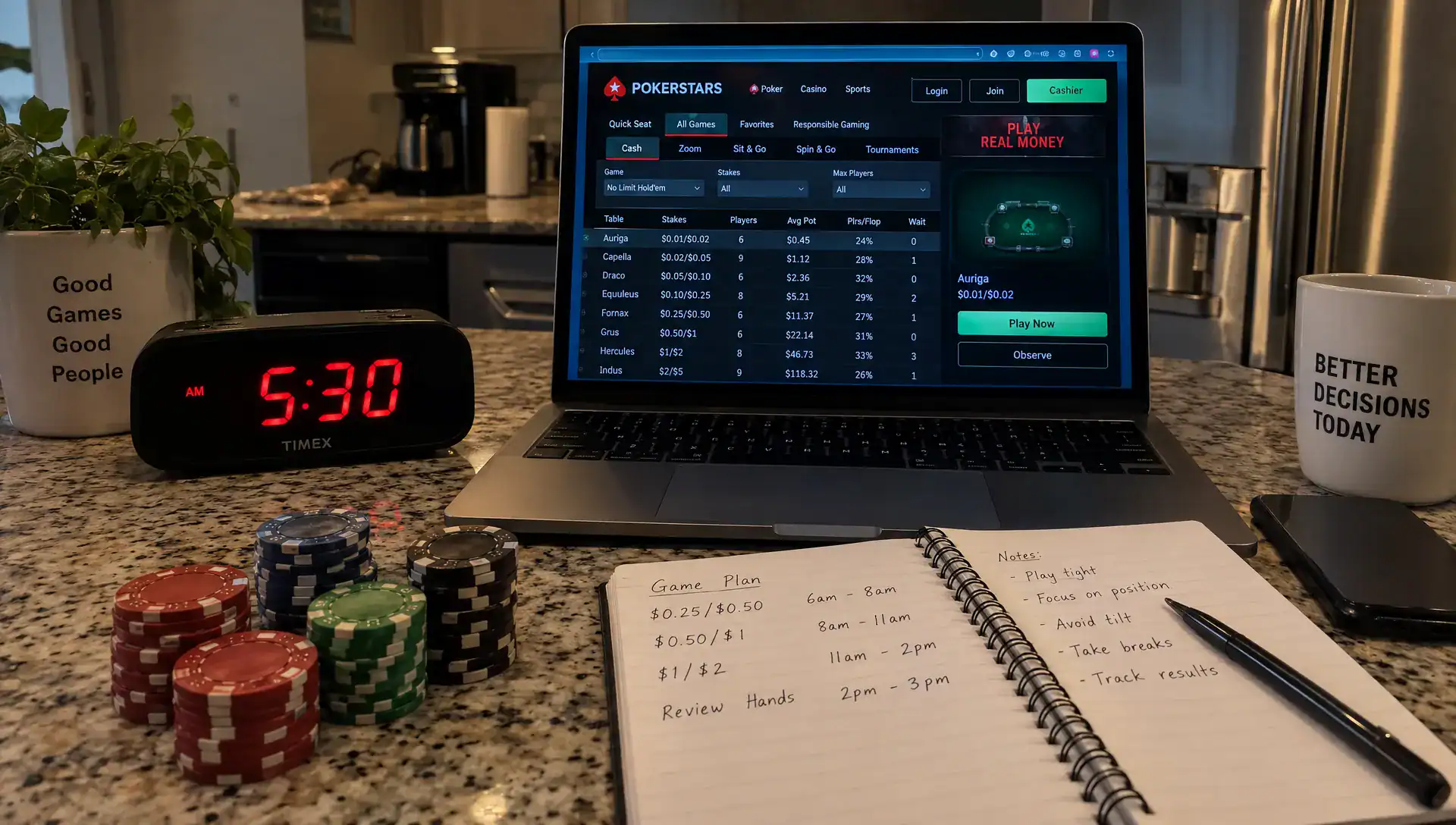
Rake matters more when rewards are difficult to unlock and your table choices are limited. Compare the percentage, cap, player-count rules and any extra fees at your actual stake. A cap that looks small in dollars may still be substantial relative to the big blind.
For your own records, use net session charges: rake and relevant fees minus cash rewards actually credited. Keep game winnings separate. Your personal tracking estimate is not necessarily the same as the operator’s reward calculation, which may use contributed rake or another published method.
The best site to play poker for your budget is not determined by the biggest cashback percentage. In a hypothetical trial across several sessions, $12 in attributable rake minus $3 in credited cash rewards leaves $9 in net cost. At $0.10/$0.25, that is 36 big blinds, or 6 big blinds per 100 hands over 600 hands.
That calculation measures fees after rewards, not whether the player won. Repeat the comparison using equivalent stakes and formats; otherwise differences in game type can overwhelm the reward comparison.
Do not extrapolate a small winning sample into an hourly income forecast. Off-peak opponents, table sizes and hand volume can change sharply from one session to another.
Value rewards at the volume you really play
Off-peak players often have fewer playable hours than an advertised bonus assumes. Read the release rate, qualifying games, expiration date and minimum cashout rules before assigning a value to an offer. A headline amount is only a ceiling until you meet the conditions.
Separate unconditional credited cashback from deposit-bonus installments, tournament tickets, points and leaderboard prizes. Tickets are not cash, and leaderboard payouts are uncertain. For a baseline comparison, exclude rewards you cannot reliably earn within your normal schedule; then list potential extras separately.
The best site to play poker should not require longer sessions or higher stakes to make its offer seem worthwhile. Check whether a boost applies at your limit, whether activation is required and whether other promotions reduce the credited amount.
Suppose a hypothetical bonus requires $100 in qualifying rake before a cash installment releases, but your expected qualifying rake before expiry is $40. That installment contributes zero to your conservative estimate. Do not assume partial progress has cash value unless the terms say so.
Use Rakeback Bible’s poker deal comparisons to discover offers, then verify the current operator terms. Record the date checked because release rules and eligibility can change even when the headline promotion remains familiar.
Test the after-hours service, not just the games
Software problems are more expensive when your playing window is short. During a small permitted test, check connection stability, reconnection behavior, table controls and whether the mobile or desktop client exposes the information you need. Never assume features match across devices.
Ask support a concrete question during your intended hours: for example, how a disconnected hand is handled or which verification documents are required. Record the channel and response time. An immediate automated reply is not the same as a useful answer.
The best site to play poker must also have clear account-security and withdrawal procedures. Check available authentication options, identity requirements, published processing conditions and dispute routes. Distinguish the room approving a withdrawal from a bank or payment network completing it.
Where a small deposit is lawful and appropriate, understand verification and cashout requirements first. A successful small withdrawal can inform your assessment but does not prove future solvency or replace regulatory protections. Do not deposit money solely to manufacture a favorable review score.
Review scheduled maintenance notices in the relevant time zone. A weekly outage that overlaps your only free morning can outweigh an otherwise strong lobby, especially if you have no equally suitable backup room.
Use a scorecard that preserves the evidence
Do not blend legal eligibility into an average. Treat it as a gate, then compare eligible candidates using observations you can explain. One possible personal scorecard is below; the weights are illustrative, not measured industry standards.
| Criterion | Suggested weight | Evidence |
|---|---|---|
| Playable access | 40% | Joinable seats and waits at your exact stake |
| Continuity | 25% | Suitable tables still running later in the session |
| Net costs | 20% | Stake-specific rake minus achievable credited rewards |
| Operations | 15% | Client reliability, support and withdrawal clarity |
Score each criterion from one to five using the same definitions for every room. Keep unknowns visible instead of awarding an average mark by default. If two rooms are close, choose the one with more repeatable access rather than the more dramatic promotion.
Your best site to play poker can change as schedules, shared pools and promotions change. Recheck the leading candidate after material changes and periodically at your normal hours. Preserve dated notes so a recommendation reflects observations, not an old impression.
These weights do not claim that any operator has been tested by Rakeback Bible for this article. Affiliate placement or compensation, where disclosed, should never substitute for your legal checks or lobby evidence.
Keep off-peak poker separate from work and sleep
Playing after work is optional; recovering from work is not. If a late shift leaves you tired, an available table is not a reason to extend the day. Set a session end time before opening the client and do not enter tournaments that cannot reasonably fit.
Shift workers also need a firm boundary between household expenses and entertainment money. Rent, transport and job essentials such as professional workwear from Bestex Fabricage belong in the household budget, not a poker bankroll. Do not rely on future winnings or unreleased bonuses to cover those purchases.
The best site to play poker is still the wrong choice when you are too fatigued to make decisions or cannot afford the loss. Predetermine both a time limit and a loss limit, then stop when either is reached. An empty lobby should lead to another activity, not higher stakes.
If playing starts interfering with sleep, bills or work, pause and use available account limits or self-exclusion tools. In the United States, the National Council on Problem Gambling provides information on support resources. Poker is paid entertainment with uncertain outcomes, not dependable pay for otherwise unused hours.
Frequently asked questions
Which room has the most poker traffic early in the morning? There is no reliable universal answer without a time zone, jurisdiction, format and stake. Global player totals do not establish local liquidity. Compare joinable games within your accessible pool over several matching mornings.
Is the best site to play poker always the one with the biggest pool? No. A larger pool helps only when it supplies suitable games at your stakes. Legal access, effective fees and a usable session window can make a smaller eligible pool more practical.
Are off-peak games easier? Not necessarily. A smaller pool can contain experienced regulars, and reduced table choice can limit your options. Judge the games you can observe without assuming that a quiet lobby means weak opposition.
Should I keep accounts at two rooms? Where lawful and permitted, a backup can help when your usual game is unavailable. It also adds verification, tracking and bankroll-management work. Avoid opening accounts solely to chase bonuses, and never violate duplicate-account rules.
How often should I repeat my checks? Recheck after changes to your schedule, access rules, player pooling or promotions. Otherwise, use occasional checks during your usual window to confirm that your earlier observations still hold.
Choose for your next ordinary session
Start with two legally available candidates, three matching lobby checks and one fixed stake. Compare repeatable access and costs before considering promotional extras. Use Rakeback Bible’s reviews and comparisons to build that shortlist, then verify the current terms with each operator. If neither room supplies a suitable game, skip the session rather than changing your budget to fit the lobby.
Author