
How to Find the Best Poker Websites for Low-Volume Players
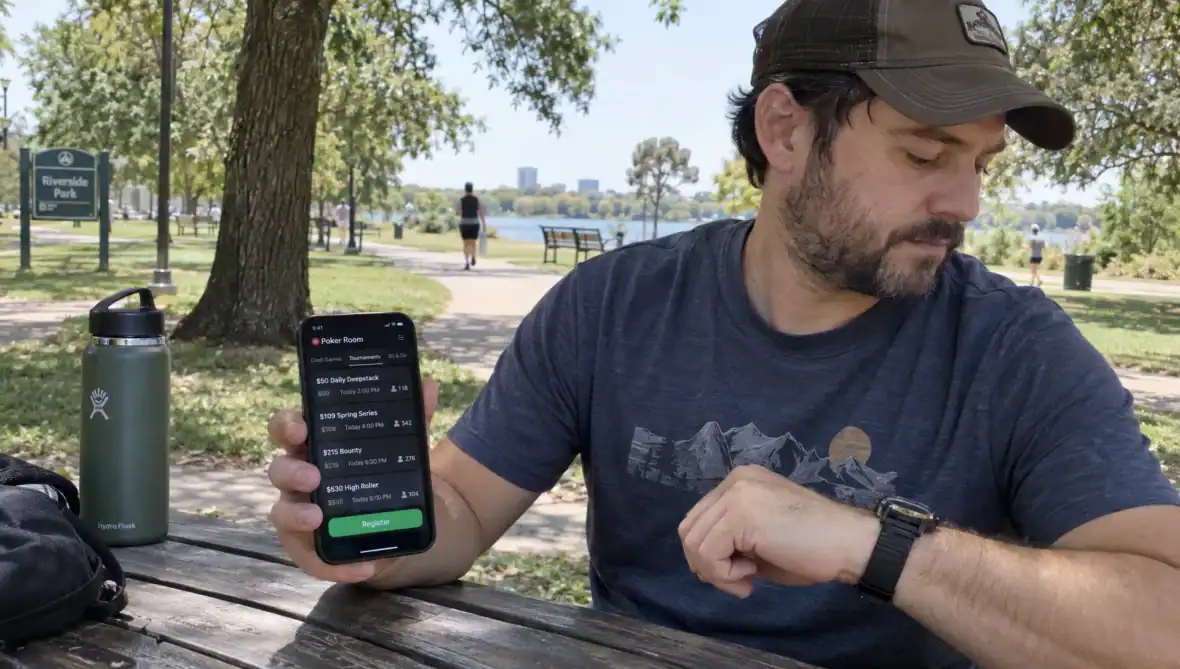
Playing twice a week changes what a good poker room looks like. The best poker websites for occasional players are not necessarily those advertising the biggest bonuses or highest VIP tiers. They are the ones with suitable games when you log in, manageable costs and rewards you can actually collect without changing your schedule.
A promotion built around thousands of hands can offer little to someone playing a few hundred. Likewise, a huge tournament schedule is not useful if the affordable events start too late or regularly run beyond your available time.
Start with a realistic monthly playing budget, your preferred stakes and the hours you normally have available. Then compare rooms against those constraints. This guide explains how to assess legality, traffic, rake, promotions and withdrawals through that low-volume lens, rather than treating an advertised maximum as the value you will receive. It also separates checks you can make before depositing from those that require a small, controlled trial.
What the best poker websites offer low-volume players
Low volume describes how much you play, not how well you play. A knowledgeable cash-game player logging two short sessions each week has different needs from a tournament regular playing several evenings, even if both use the same stakes.
For this comparison, define your own expected activity. You might plan for eight sessions per month, roughly 800 cash-game hands or a dozen small tournaments. These are planning examples, not targets to reach.
The right room should work at your existing activity level. Its appeal should not depend on playing longer, depositing more or moving up in stakes to unlock benefits.
Separate requirements from preferences. Legal access, affordable games and acceptable withdrawal conditions are requirements. A particular table theme or leaderboard is a preference. Reject rooms that fail the requirements before comparing extras.
This approach also prevents a common mistake: selecting a room because experienced, high-volume players recommend it. Their effective rakeback, software needs and tolerance for difficult games may bear little resemblance to yours.
Check legal access before comparing promotions
A website accepting your registration does not establish that it is licensed to offer real-money poker where you are located. For US players, state authorization, physical location and the specific product being offered all matter.
When shortlisting the best poker websites, check the operator through the relevant regulator rather than relying on an affiliate badge or a claim that a room is “US-friendly.” Official resources include the New Jersey Division of Gaming Enforcement and Michigan Gaming Control Board.
Confirm the legal entity, approved website and availability of peer-to-peer poker. Authorization for an online casino does not by itself establish that an active poker room is available. Check minimum-age rules and geolocation requirements too. Do not use a VPN to bypass restrictions.
Our guide to choosing poker sites by state explores those location checks in more detail.
Keep product types separate. Play-money poker generally uses chips without cash redemption. Sweepstakes-style platforms operate under different promotional structures and eligibility rules. Neither should be treated as interchangeable with state-regulated real-money poker. If real-money play is unavailable, do not assume another model provides equivalent protections simply because its tables look similar.
Match traffic to your actual playing window
A room can have substantial total traffic and still offer little at your stakes during your free hour. Check the lobby on the days and at the times you expect to play, not just during a major weekend promotion.
For cash games, look for several active tables at your preferred limit. Note waiting lists, minimum buy-ins and whether games remain available outside peak hours. One full table provides less flexibility than several tables where you can comfortably find a seat.
The best poker websites for short sessions reduce waiting and scheduling friction. You should not have to move up in stakes because your usual game is empty.
For tournaments, inspect starting times, late registration, blind structures and likely duration. A low entry price does not make an event suitable if you cannot stay until it finishes. Re-entry options also deserve attention because repeated entries can turn a small advertised buy-in into a larger session expense.
Check player-pool conditions separately from traffic. Busy tables are not automatically easy tables, and lobby statistics cannot guarantee profitability. Rakeback Bible’s guide to choosing an appropriate poker table explains useful selection signals. Treat those signals as context, not a promise that a game will be beatable.
Compare playing costs before rewards
Cash-game rake and tournament fees
Rake is the charge taken by the room, commonly from qualifying cash-game pots. Tournament fees are usually included in or added to the entry price. Both affect your results before any rewards are considered.
For cash games, compare the percentage, cap and conditions at the stakes and table sizes you will actually use. A lower cap at high stakes tells you little about the cost of micro-stakes play. Check whether additional promotional or jackpot deductions apply.
A useful comparison of the best poker websites starts with these underlying charges, then subtracts realistically obtainable rewards. A high cashback percentage does not automatically offset a more expensive rake structure.
Calculate costs at your own volume
For tournaments, separate the prize-pool contribution from the operator fee. In a hypothetical $5 plus $0.50 event, the $0.50 is the fee. Twelve entries create $6 in fees before any re-entries. If an eligible reward returned 20% of those fees, the value would be $1.20.
For cash games, use your own records where available. Distinguish total rake removed from a pot from the amount attributed to your account for rewards. Rooms can use different attribution methods, which changes what a headline percentage means.
Keep playing cost separate from poker results. Rake minus earned rewards, plus transaction charges, measures one part of the expense. It does not predict wins or losses against other players, which can be much larger.
Value rewards at your expected monthly activity
Compare reachable cashback, not maximum percentages
Suppose you expect 800 hands per month and, purely for illustration, average $0.03 in reward-eligible attributed rake per hand. That produces $24 in monthly attributed rake. These assumptions are examples, not estimates for a particular room or stake.
| Hypothetical reward structure | Requirement | Reward at $24 attributed rake |
|---|---|---|
| Room A: 25% cash rakeback | No minimum or additional conditions | $6 |
| Room B: 50% cash rakeback | At least $100 attributed rake within the month, nothing below | $0 |
For that player, Room A delivers more despite advertising a smaller percentage. When comparing the best poker websites, calculate what your expected activity earns below each threshold, not only what happens after reaching the top tier.
Check whether rewards are automatic, require activation or depend on a claim deadline. Establish whether the payout is withdrawable cash, restricted bonus funds, tickets or points. If points expire, record the deadline. If a tier resets monthly, unused progress may have no future value.
Discount bonuses you cannot clear
A deposit match is not necessarily money you can withdraw immediately. It may release in increments as you generate qualifying rake, with a fixed deadline and game restrictions.
Consider a hypothetical $200 bonus releasing $5 for every $25 of eligible rake. Clearing all $200 requires $1,000 in qualifying rake. If it expires after 30 days and you generate only $24 during that period, no $5 increment clears.
The best poker websites for limited schedules make the achievable value easy to understand. Ask what happens to partial progress, whether a promotional code is required and whether accepting one offer excludes another.
Do not increase your volume to rescue an expiring bonus. Spending more time or money than planned can outweigh the reward. Also avoid counting leaderboard prizes or random rewards as dependable cashback. Unless their value is guaranteed under conditions you already expect to meet, leave them outside your baseline comparison.
Examine withdrawals before making a deposit
A smooth deposit does not tell you how straightforward a withdrawal will be. Read the cashier rules first, including minimum withdrawals, supported methods, operator charges and any payment-provider or currency-conversion costs.
Identity verification may require documents confirming your identity, address and payment ownership. Check how documents must be submitted and use the operator’s official secure channel. Do not send identification to an affiliate, an unsolicited contact or someone claiming to expedite approval privately.
The best poker websites should provide understandable withdrawal conditions and a clear support route. Look for an explanation of internal processing versus the additional time a bank or payment service may need. Neither should be assumed instantaneous.
Find out whether withdrawals must return to the original deposit method and what happens if that method cannot receive funds. Check how an active bonus affects access to deposited funds and rewards. A small fixed withdrawal fee can consume much of a low-volume player’s cashback.
Ask one specific question before depositing, such as: “Can I withdraw to this payment method after depositing with it, and what verification is required?” Save the response and relevant terms. Also identify the complaint process and any regulator or dispute-resolution route that actually applies to your account. An offshore license should not be assumed to provide your home state’s protections.
Test software for a short, realistic session
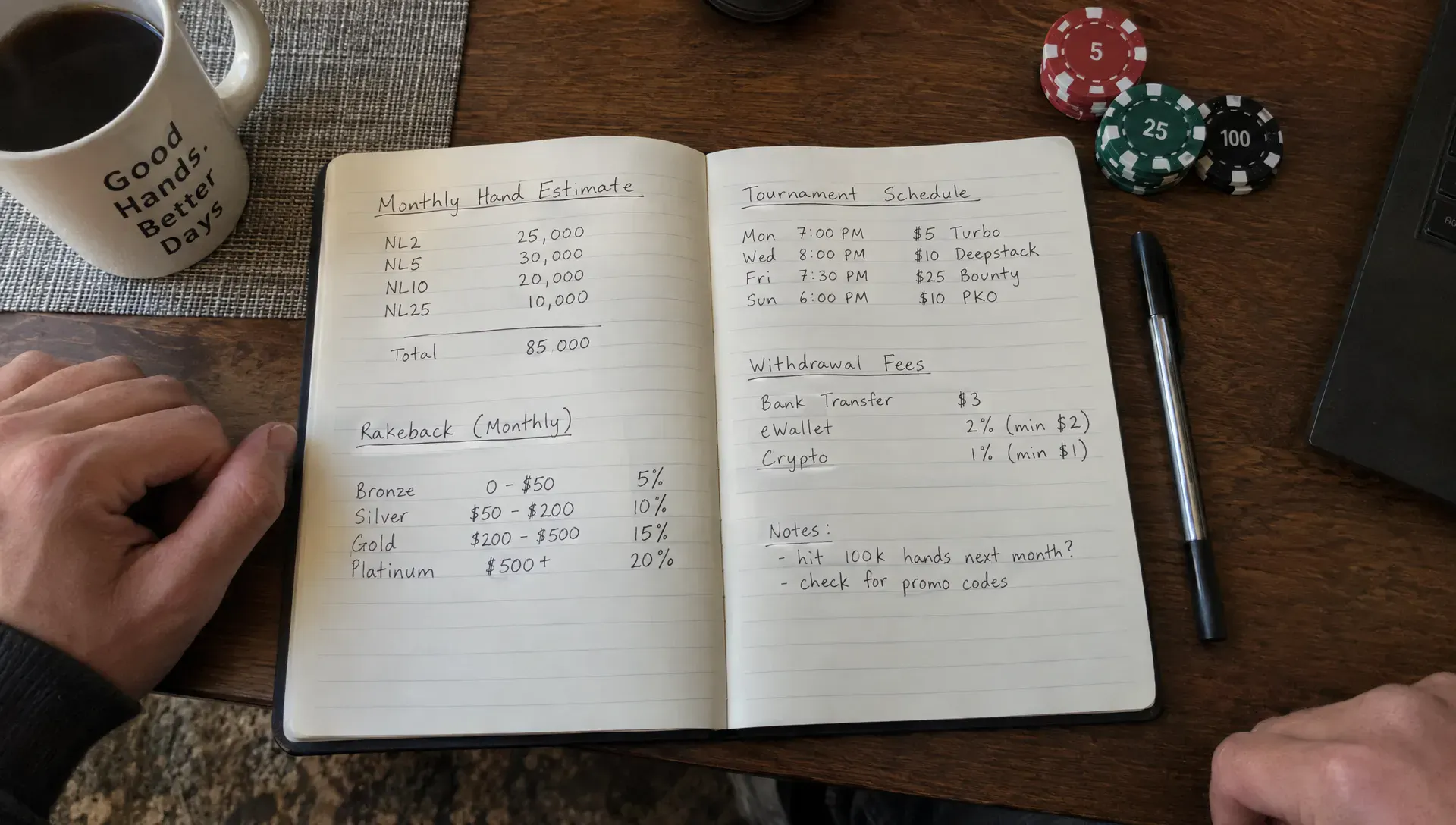
Occasional players benefit from software that takes little time to navigate. Test whether stakes, fees and tournament structures are easy to find. Check bet sizing, table controls, hand-history access and connection stability on the device you actually plan to use.
If you mainly play on a phone, do not judge the experience from desktop screenshots. Confirm that important controls remain readable and that account, cashier and responsible-play settings are accessible. A polished lobby is less useful if basic actions become awkward at the table.
When testing the best poker websites, prioritize reliability over features you will rarely use. Multi-tabling capacity has limited value if you normally play one table for 45 minutes.
Read the disconnection policy, especially for tournaments. Check support availability during your playing hours and whether you can obtain help without leaving an active game unattended. Review the room’s rules on third-party software, bots and real-time assistance. Never assume a tool is permitted because it works elsewhere.
Keep your first test small. Software familiarity should not require a large deposit or a commitment to a lengthy promotional challenge.
Make budget controls part of the comparison
Your poker allocation should be money you can afford to lose, separate from essential spending, savings and debt payments. Keep practical expenses spare too, for unexpected bills or charges.
Set a monthly spending ceiling and a session-length limit before comparing promotions. Cash-game players should decide acceptable buy-ins and whether another buy-in is permitted. Tournament players should budget for re-entries explicitly or choose a no-re-entry plan.
The best poker websites for your needs should also offer usable account controls. Check for deposit limits, time reminders, cooling-off options and self-exclusion. Availability and how these tools operate can differ, so inspect the actual settings rather than assuming they exist.
A bonus deadline is not a reason to override your limits. Nor should a losing session become a reason to extend play. Skill matters in poker, but short-term results involve substantial variance, and neither experience nor rewards guarantee profit.
If you repeatedly exceed your budget, chase losses or conceal your gambling, stop playing and seek support. In the US, the National Council on Problem Gambling’s responsible gambling resources provide a starting point for finding help. Poker-site selection cannot resolve harmful gambling behavior.
Run a controlled two-session trial
First session: confirm the essentials
After completing the legal and terms checks, use the smallest practical deposit that fits your budget. Where free-play testing is available, use it to learn controls first, while recognizing that free-play traffic and opponent behavior may differ from cash games.
During a short real-money session, record whether your intended games were available, how long you waited and whether the interface behaved reliably. Note starting and ending balances, relevant charges and any reward progress shown.
A practical shortlist of the best poker websites should survive this ordinary session, not just look attractive on a promotional page. Save account statements or hand histories where available so you are not relying on memory.
Second session: check repeatability
Return during another normal playing window. Confirm that game availability was not a one-off and that the same stakes remain practical. Recheck whether reward progress matches the published rules.
If your balance and the minimum withdrawal permit, make a modest withdrawal request after completing verification. This tests the process once, not a guarantee of future service. Avoid unnecessary transfers if fees make the experiment expensive.
Record the outcome in a simple comparison sheet. Stop the trial if you discover unclear charges, unresolved access problems or pressure to deposit again. There is no need to keep testing a room that has already failed a requirement.
Build a shortlist without letting rewards dominate
Use a small scorecard rather than an elaborate ranking formula. Mark legal eligibility, suitable stakes and acceptable payment rules as pass-or-fail conditions. Only score convenience and promotional value after those conditions are satisfied.
| Comparison area | Evidence to record |
|---|---|
| Schedule fit | Available tables or suitable tournaments during your hours |
| Playing cost | Relevant rake, caps, entry fees and extra deductions |
| Achievable rewards | Cash value at your expected volume, after conditions |
| Payments | Verification requirements, withdrawal minimums and charges |
| Usability and safety | Reliable controls, support access and account limits |
This keeps the best poker websites from becoming whichever rooms have the most eye-catching banners. For a low-volume player, a reliable game and straightforward withdrawal process may matter more than a few extra dollars in theoretical cashback.
Keep dated notes or screenshots of important terms. Promotions, payment policies and game availability can change. Reassess when your schedule changes or a room alters its conditions, not after every losing session.
You also do not need multiple active accounts to feel thorough. Splitting limited play across several rooms can leave reward balances below redemption thresholds and make spending harder to track. One suitable room may be more practical than several partially used offers.
Frequently asked questions
Is rakeback worth comparing if I only play occasionally? Yes, but focus on cash you can actually receive. A modest automatic reward may be more useful than a higher tier requiring activity beyond your schedule. Check redemption minimums and expiry rules.
Should beginners choose play-money poker first? Play-money games can help you learn rules and software without risking a cash bankroll. They do not reliably reproduce real-money strategy or player behavior. Keep learning the interface separate from evaluating whether you can afford real-money play.
Are the best poker websites always the busiest? No. Overall traffic matters less than available games at your stakes and during your playing hours. Tournament timing, fees and withdrawal conditions can outweigh the size of the total player pool.
Can occasional players make a reliable income from poker? Do not budget on that assumption. Limited volume provides fewer observations of your results, while variance, fees and opponent strength affect outcomes. Treat poker as discretionary spending, not a source for essential bills.
Should I deposit more to qualify for a bigger bonus? Not simply to increase the advertised match. Calculate how much can clear at your planned volume first. A larger deposit does not necessarily accelerate release and places more money with the operator.
Choose for the sessions you actually play
Start with legal access, suitable games and transparent costs. Then compare achievable rewards, payment conditions and the quality of a controlled trial. Eliminate any offer that only becomes attractive when you exceed your intended budget or playing time.
Use Rakeback Bible’s reviews and deal comparisons to investigate the best poker websites for your shortlist, then confirm current conditions directly with each operator. The useful number is not the largest bonus on the page. It is the value available within the poker schedule and spending limits you already chose.


18+ | Further Terms Apply | Play Safe | www.begambleaware.org | #ad

18+ | Further Terms Apply | Play Safe | www.begambleaware.org | #ad