
Your First Online Poker Tournament Registration Checklist

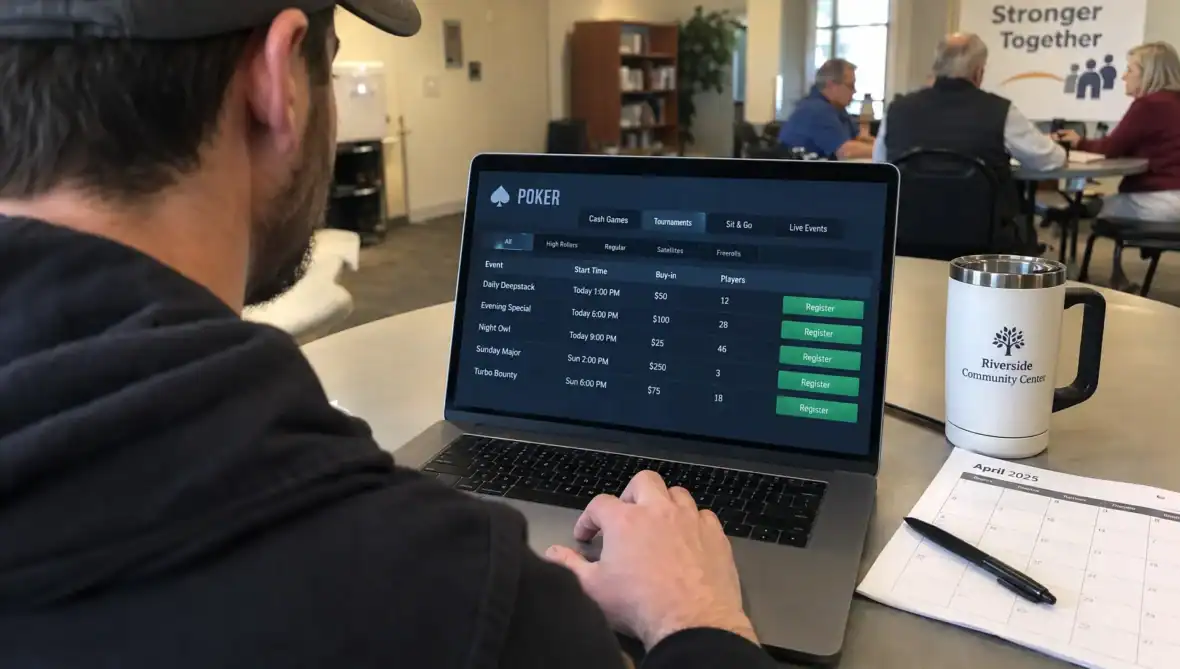
Your first online poker tournament registration should start with the event details, not the biggest prize-pool banner. Before you commit money, you need to know whether you can legally play, what the entry actually costs and whether you can stay until the tournament ends.
This checklist follows that decision in order, from checking your eligibility to reviewing the final confirmation screen. For a first attempt, favor a format you understand and an amount you can comfortably lose. A promotion or large guarantee should never override those basics.
Check 1: Confirm that you and the operator are eligible
Start with your physical location. An operator accepting registrations or appearing in search results does not establish that it is authorized to offer real-money poker where you are.
For US players, availability and requirements depend on the state. Check your state gambling regulator’s current website for authorized operators and follow its links rather than trusting a licensing badge alone. For example, Michigan residents can start with the Michigan Gaming Control Board. Players elsewhere should consult their own jurisdiction’s regulator.
Match the operator’s legal name and website domain, then check the minimum gambling age. Do not assume that turning 18 makes you eligible everywhere. Our guide to choosing poker sites by US state explains this location-first approach.
Before entering an online poker tournament, confirm any physical-location checks, residency conditions and account restrictions that apply to you. Do not use a VPN or another workaround to bypass eligibility controls. If you cannot establish that the operator is authorized to serve your location, stop before depositing or uploading identification.
Check 2: Prepare your account and withdrawal route
Complete account setup well before the event you want to enter. Verification, payment reviews or software installation can take longer than expected, and a tournament countdown is a poor reason to rush them.
Use accurate personal details that match your documents and payment account. Create a unique password and enable two-factor authentication if available. Check whether the room requires identity, address or payment-ownership verification before play or withdrawal.
Our explanation of how real-money poker accounts are verified can help you prepare the appropriate documents. Submit them only through the operator’s verified process, not an unsolicited message or social-media account.
Next, review deposits and withdrawals separately. A convenient deposit method may not support withdrawals, and cashout conditions can include minimum amounts, processing periods or additional checks. Look for currency conversion costs and payment-provider charges too.
Your online poker tournament preparation should include knowing how you would withdraw an eligible balance, not just how to fund the entry. If the cashier’s terms are unclear, ask support before depositing. Keep the reply and relevant transaction records, without storing sensitive documents in an unsecured folder.
Check 3: Set a total spending cap, including fees
Choose your entertainment budget before browsing prize pools. The amount should be affordable to lose completely, without affecting bills, savings or other commitments. Do not borrow to enter.
Read the buy-in breakdown rather than relying on the headline amount. An entry advertised as $2 + $0.25 ordinarily means $2 goes toward the prize pool and $0.25 is the operator’s fee. Confirm the actual treatment in that event’s rules, particularly for bounty formats.
Here is an illustrative calculation, not a current offer:
| Entry decision | Prize-pool contributions | Entry fees | Total spent |
|---|---|---|---|
| One entry | $2.00 | $0.25 | $2.25 |
| Two entries in total | $4.00 | $0.50 | $4.50 |
| Three entries in total | $6.00 | $0.75 | $6.75 |
These totals assume each entry costs the same. Rebuys and add-ons can have different prices or fee arrangements, so calculate them separately.
For your first online poker tournament, a one-entry spending rule makes the decision simpler: once eliminated, you stop. Set any available deposit or spending limits before playing, while checking exactly what those controls cover. A deposit limit does not necessarily cap spending from money already in your account.
Check 4: Choose a format you can explain back
A low price does not make every event beginner-friendly. Before registering, make sure you understand when it starts, how players are eliminated and what winners receive.
| Format | What to confirm before entering |
|---|---|
| Scheduled multi-table tournament (MTT) | Published start time, late registration and possible duration |
| Sit & Go | Number of entrants required to start and the payout structure |
| Freezeout | Whether elimination ends your participation, with no re-entry or rebuy |
| Re-entry event | Entry limit, re-entry deadline and the cost of another attempt |
| Bounty or progressive knockout | How the entry is divided and how bounty awards work |
| Satellite | The exact ticket, seat or package awarded and its restrictions |
| Freeroll | Whether entry is genuinely free and whether other eligibility conditions apply |
A straightforward freezeout removes the need to decide whether to buy another entry. A freeroll can help you learn registration and table controls without an entry charge, but check whether a deposit, ticket or previous activity is required to qualify.
Also confirm the poker variant. Texas Hold’em, Omaha and mixed games have different rules. For your first event, avoid combining unfamiliar tournament procedures with a game you have not practiced.
Check 5: Read the online poker tournament structure
Open the detailed lobby or structure tab. The starting stack alone tells you little about how much playing room you will have.
Compare that stack with the blinds. A hypothetical 5,000-chip starting stack at blinds of 25/50 equals 100 big blinds. The same stack at 100/200 equals only 25 big blinds. Antes add further forced costs, so inspect those too.
Read the blind schedule, level duration and speed label together. Terms such as “turbo” and “hyper” are useful warnings that blinds rise quickly, but their exact settings vary between operators. Short levels can make decisions more urgent, which is not necessarily what you want while learning the interface.
Check the table size as well. Heads-up, six-handed and full-ring events create different playing experiences. Make sure the listed game matches what you intended to enter.
Finally, compare the likely time commitment with your schedule. Look for a published estimate, comparable completed events or information from support, but treat any estimate as uncertain. A large field and a slow structure can create a long session. If you have a firm appointment later, choose another event rather than relying on an early exit.
Check 6: Verify the clock, late entry and cancellation rules
An online poker tournament start time is useful only when you know which time zone the lobby displays. Check whether it follows your device, account settings or a fixed server clock. Daylight saving changes can also affect a schedule you remember from a previous week.
Distinguish the scheduled start from the late-registration deadline. Joining late usually means receiving the stated entry stack against higher blinds, not restarting the event at its opening levels. Check whether the event provides any different conditions.
Review the re-entry window separately. Late registration being open does not automatically tell you how many entries are permitted or whether you are eligible to enter again.
Before paying, locate the unregistration policy. Find out when you can cancel, what is returned and whether a ticket comes back as a ticket rather than cash. Check automatic seat assignments if you enter through a satellite, because those rules may differ.
Confirm scheduled breaks and whether the event can continue on another day. Save the tournament name, date and event ID so you can find the correct lobby again. Similar names across daily schedules can make it surprisingly easy to register for the wrong event.
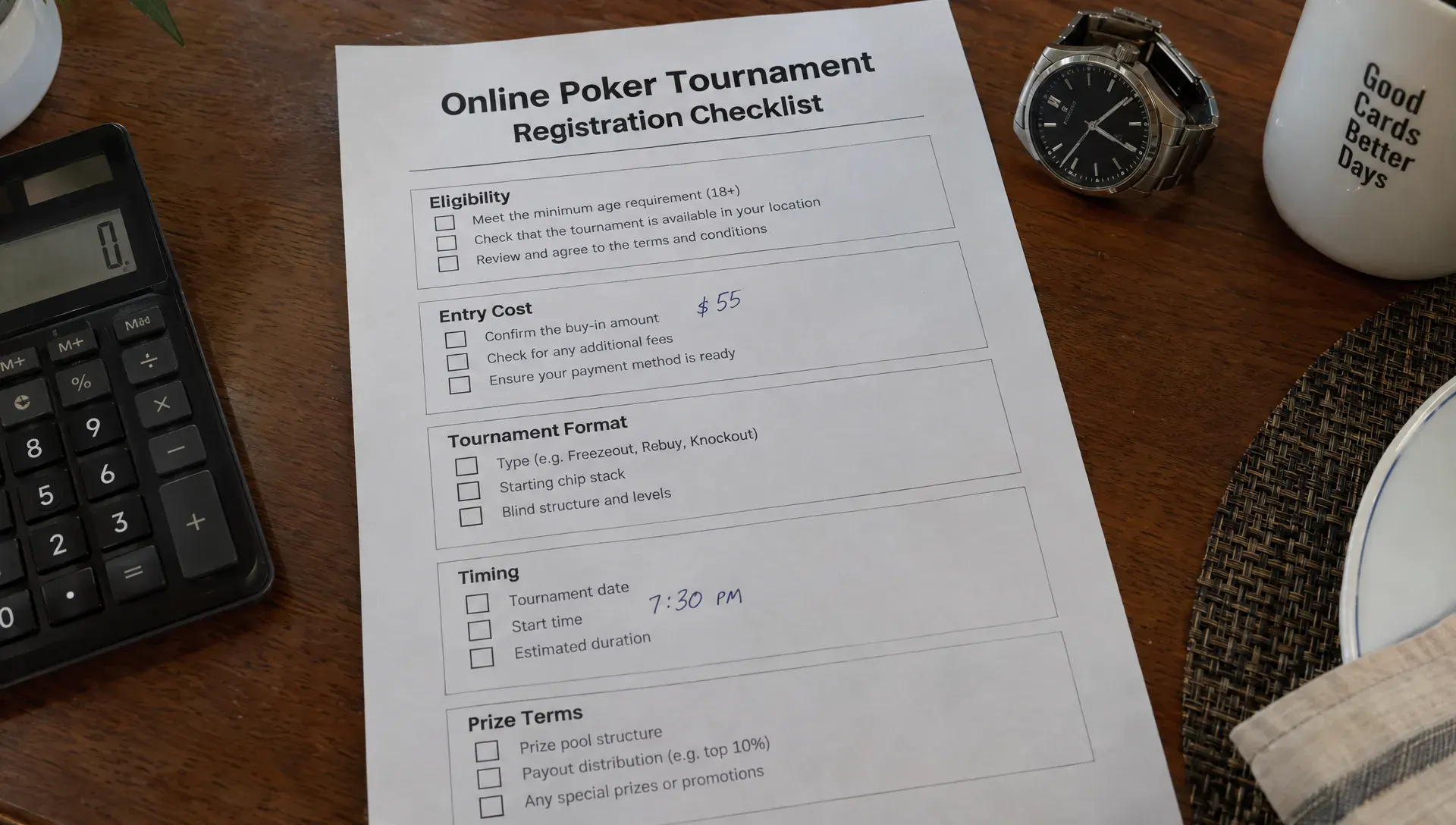
Check 7: Understand what the prizes actually represent
Separate the advertised prize pool from your possible payout. A guarantee is an advertised minimum pool subject to the event’s terms, not an amount awarded to each participant. The displayed pool and payout schedule may change as registration develops.
Inspect how many places are paid and how the money is distributed. Some structures place much more of the pool at the top. Finishing “in the money” does not necessarily mean making a net profit after entry fees and any additional attempts.
For bounty events, distinguish finishing-position prizes from knockout rewards. Read how bounties are credited and, in progressive formats, how the bounty changes. Do not assume the displayed bounty amount is entirely payable immediately to the player making the elimination.
A satellite requires an extra check: the prize may be a restricted entry rather than withdrawable cash. Confirm its destination event, expiration, transferability and any mandatory registration. If it includes a live package, inspect which travel expenses are excluded.
Before committing to an online poker tournament, you should be able to state what you can win and what restrictions come with it. Keep records of entries and prizes, and check the tax reporting requirements that apply to your circumstances.
Check 8: Treat bonuses and rakeback as secondary
Rewards can affect value, but only after an event fits your eligibility, budget and schedule. Do not increase your entry amount or add sessions merely to qualify for a promotion.
Check whether tournament fees count toward the reward at all. Then look for enrollment requirements, qualifying dates, exclusions, minimum activity and expiry conditions. A headline percentage may apply only to eligible fees or depend on a reward tier you have not reached.
Keep the arithmetic proportionate. In a hypothetical offer returning 20% of a qualifying $0.25 entry fee, the reward would be $0.05. That is not 20% of the full buy-in and does not protect you from losing your entry.
Deposit bonuses may release gradually rather than becoming immediately withdrawable cash. They can also interact with other rewards. Our guide to evaluating an online poker deposit bonus explains the terms to inspect before opting in.
Verify the current terms on the operator’s own promotion page before your online poker tournament registration. Save a dated copy or screenshot of the relevant conditions, excluding private account details. If an advertised deal and the account screen disagree, resolve the discrepancy before paying rather than assuming a later adjustment.
Check 9: Test the software and read the playing rules
Install updates and sign in early enough to resolve problems without pressure. If practice tables are available, use them to find the fold, call and raise controls. Learn where to see your remaining time, open the lobby and contact support.
Check your connection and power supply, then close unnecessary applications. On a phone, consider battery life, incoming-call interruptions and whether the smaller display makes amounts hard to read. Do not assume switching devices mid-event will be seamless.
Read the disconnection and cancellation policies. A dropped connection does not ordinarily pause the whole event for you; depending on the rules and situation, your hands may be folded and forced bets can continue. Refunds are governed by the operator’s policy, not by your expectation of what is fair.
Check permitted software and assistance rules too. Real-time advice tools, automation, account sharing and other prohibited assistance can put your account and funds at risk. Do not install a tool simply because another player recommends it.
For a first online poker tournament, one table is enough to learn the workflow. Avoid adding simultaneous events while you are still working out notifications, breaks and decision timers.
Check 10: Pause at the final registration screen
Treat the confirmation screen as a purchase review. Check the event ID against your notes, particularly if the room offers several versions with similar names.
Before confirming, make sure each statement is true:
- Eligibility: I meet the age, location and account requirements.
- Payment: I understand the full entry cost, currency and payment method.
- Budget: This entry fits my preset spending cap, including my re-entry decision.
- Format: I understand the game, structure and elimination rules.
- Timing: I have checked the start, late-registration deadline and available playing time.
- Prizes: I know whether awards are cash, bounties, tickets or another restricted prize.
- Terms: I have reviewed cancellation rules and any promotion I am relying on.
Read any preselected options, including automatic re-entry if offered. After confirming, check that the entry appears in your registered-events list and that the account deduction matches the displayed price. A confirmation message is more reliable than assuming a button press worked.
If anything remains unclear, skip that online poker tournament. Missing one event costs nothing, while an unwanted registration may be difficult to reverse once play begins.
Frequently Asked Questions
How much should I spend on my first tournament? Choose an amount you can comfortably lose in full and include the entry fee in that figure. There is no universal safe buy-in. A low-cost, single-entry event makes it easier to enforce a fixed entertainment budget without making decisions about additional attempts.
Can I leave after registering? You may be able to unregister before the operator’s deadline. After play starts, closing the software does not normally remove your entry or refund it. Your stack may remain in play and lose forced bets while you are absent, subject to the event’s rules.
Is late registration a good choice for a beginner? It can be convenient, but you may begin with fewer big blinds because the blinds have already increased. Starting on time generally gives you more opportunity to learn the table controls at the opening levels. Check the actual structure rather than relying on the registration label.
What if I want to enter another online poker tournament to recover a loss? Stop rather than changing your spending limit. Chasing losses is a warning sign, not a registration strategy. Consider account limits, a time-out or self-exclusion. The National Council on Problem Gambling provides information about support resources in the US.
Compare the details before you commit
Use Rakeback Bible to compare poker rooms, fees and reward offers, then verify the event details directly with the operator. Register only when eligibility, total cost, time commitment and prize conditions are clear. For a first event, an understandable structure and a firm spending limit matter more than a large promotional headline.

18+ | Further Terms Apply | Play Safe | www.begambleaware.org | #ad

18+ | Further Terms Apply | Play Safe | www.begambleaware.org | #ad

18+ | Further Terms Apply | Play Safe | www.begambleaware.org | #ad
