
What a Poker Championship Package Really Costs
Winning a poker championship package can get you a tournament seat and a place to stay without covering the full cost of attending. Flights, mandatory hotel charges, meals and qualification attempts can still leave a substantial bill. Even an advertised travel allowance may require you to pay first and claim reimbursement later.
The useful number is not the package’s headline value. It is the cash you must commit to qualify, travel and play, assuming you win nothing at the tables.
This guide covers packages for real-money championship events, particularly live tournament trips, rather than social poker apps. The worked budget below uses illustrative figures, not a current offer or destination price quote. Use the same method with an organizer’s written terms before buying a satellite entry or booking travel.
What a poker championship package actually includes
A package is a collection of specific benefits, not a promise of an all-expenses-paid trip. Start by separating tournament access, accommodation and travel support.
Tournament access: Identify the exact event, starting flight and number of entries. A seat in a preliminary event is not interchangeable with a main-event entry. Check whether the stated buy-in includes the tournament’s administrative fee and whether any additional registration charge remains payable.
Accommodation: Confirm the property, room type, occupancy allowance and covered nights. “Six nights included” does not necessarily mean six nights that match your preferred arrival and departure dates. Ask whether taxes, mandatory property fees and extra-person charges are included.
Travel support: Establish whether the organizer books your flight, pays an allowance before departure or reimburses approved expenses afterward. These arrangements create different cash requirements.
Also check who receives the benefits. A room may accommodate two people while the travel allowance covers only the qualifying player. Guest meals, flights and event access should not be assumed.
Save the complete terms rather than relying on a promotional graphic. If a benefit is not clearly specified, ask for written confirmation before assigning it a value.
A worked budget: a $5,000 package with $1,140 still to pay
Consider an illustrative poker championship package advertised at $5,000. It includes $3,500 in tournament entries, six hotel nights valued at $1,200 and a $300 flight allowance.
For this example, assume the organizer pays the covered room rate directly. The player travels for seven days and the allowance can be used in full.
| Budget item | Estimated cost | Package coverage | Player pays |
|---|---|---|---|
| Listed tournament entries | $3,500 | $3,500 | $0 |
| Six hotel nights | $1,200 | $1,200 | $0 |
| Round-trip flight | $700 | $300 | $400 |
| Mandatory hotel charges, six nights at $35 | $210 | $0 | $210 |
| Meals, seven days at $50 | $350 | $0 | $350 |
| Airport and local transportation | $140 | $0 | $140 |
| Payment and currency-conversion charges | $40 | $0 | $40 |
| Total | $6,140 | $5,000 | $1,140 |
These amounts are budgeting assumptions, not typical rates. Replace every line with an actual quote and remove costs explicitly covered by your offer.
If the player also spent $180 on qualification attempts, their unreimbursed cash spending becomes $1,320 before any optional entries or extra nights.
The $5,000 package has not become worthless. It simply does not eliminate the remaining bill. Nor does its advertised value establish what the player would have paid for the same trip independently.
Separate final expenses from upfront cash requirements
A budget can balance on paper while leaving you short of money at check-in. For a poker championship trip, distinguish money spent permanently from money temporarily tied up.
A hotel may require a refundable security or incidental deposit even when the room is prepaid. That deposit is not necessarily a final expense, but you still need sufficient available funds or card capacity. Debit-card holds can restrict money you intended to use for meals or transportation.
In the example above, a $250 refundable deposit increases the cash committed across qualification and travel from $1,320 to $1,570 until it is released. If the $300 flight allowance arrives only after reimbursement approval, another $300 must be funded temporarily.
Confirm the payment timeline before booking. Find out whether receipts must show the player’s name, whether certain booking channels are excluded and when claims must be submitted.
Keep emergency return-travel money separate. An expected reimbursement, a pending withdrawal or a possible tournament cash is not a dependable substitute for accessible funds.
Count every satellite attempt, not just the winning one
A $60 satellite entry is the price of an attempt, not the price of a package. If you enter three times before qualifying, your acquisition cost is $180. If none succeeds, you have spent $180 and have no package.
For any poker championship qualification route, set the maximum spend before the first attempt. Include earlier feeder events, re-entries and add-ons where the format allows them. Small transactions across several sessions are easy to overlook.
Record the total amount debited, not just the portion allocated to the prize pool. A ticket advertised as “$50 + $5” costs $55 to enter. Likewise, a promotional credit should only reduce your cash budget if you can actually use it for that event under its terms.
Rakeback Bible’s introduction to poker tournaments explains the distinction between satellites and other tournament formats if you are comparing qualification routes.
Do not estimate your likelihood of qualifying from the number of entrants alone. Seat allocations, tournament structure and your performance all matter. A spending cap is more dependable than assuming you will win within a particular number of attempts.
Once that cap is reached, stop. Losing previous entries does not make the next attempt cheaper or more likely to succeed.
Compare usable value, not the largest advertised number
A poker championship package can carry a high face value while being a poor fit for your plans. A nontransferable seat is not equivalent to cash, and an unwanted hotel upgrade does not automatically justify a higher valuation.
Compare each offer against what you would otherwise buy for the same trip. Use the same event, dates, room occupancy and flight requirements for both options.
For accommodation, compare the included room with a realistic alternative after taxes and mandatory fees. Do not use the cheapest room advertised for an unrelated weekday. Conversely, do not accept a premium valuation solely because the organizer uses an expensive property.
For tournament entries, ask whether you genuinely intended to play every included event. Two overlapping tournaments may be less useful than their combined face value suggests. Check what happens if you remain active in one when the other begins.
For allowances, count only the amount you can redeem. A reimbursement limited to eligible airfare does not necessarily become spending money when your flight costs less than the allowance.
Finally, check transfer and cancellation rights. A smaller package with suitable dates may be more useful than a larger one you cannot attend, sell or exchange. Usable value depends on your circumstances, not just the organizer’s arithmetic.
Budget for the final day, not your expected elimination
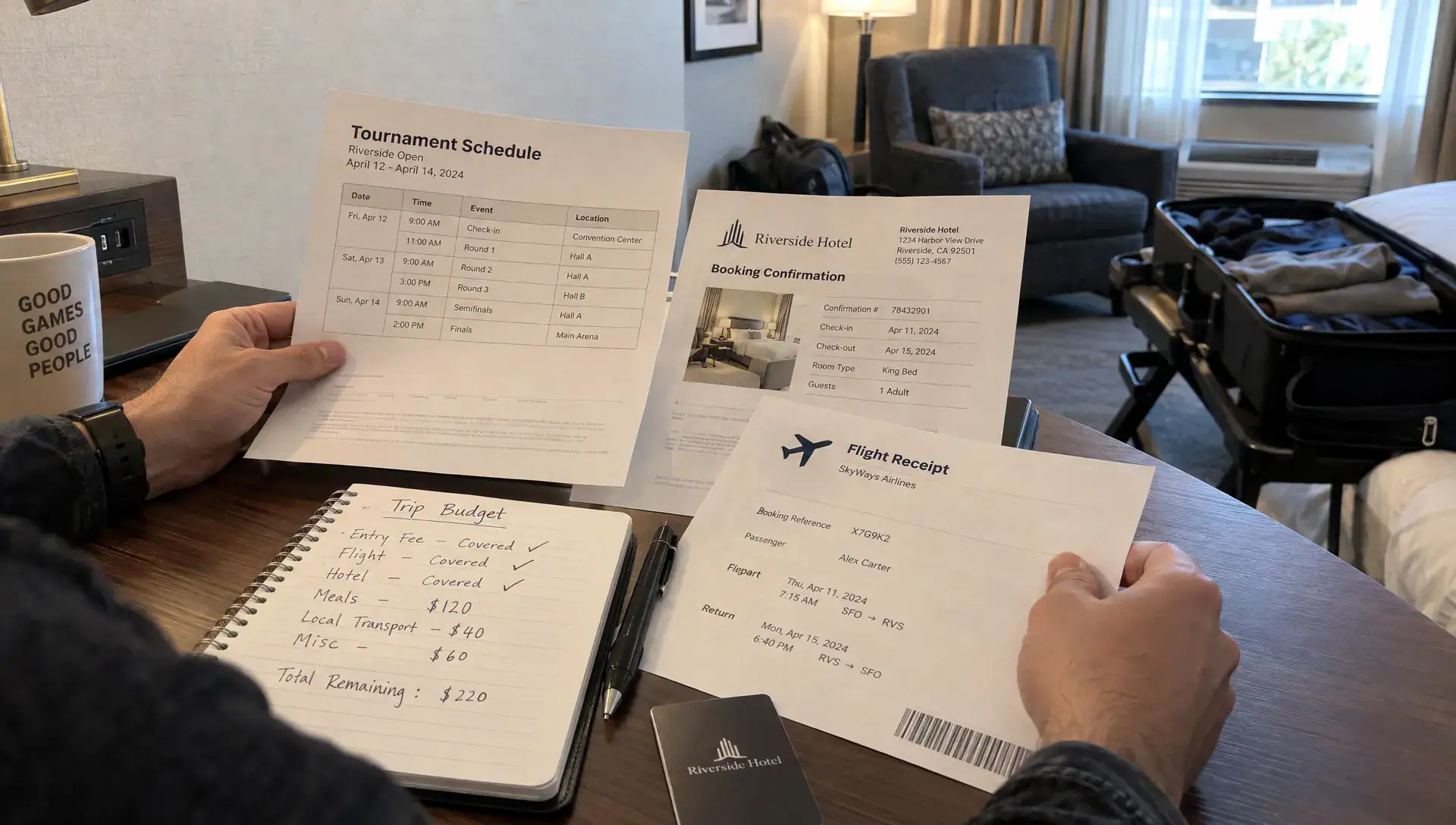
Tournament travel creates an unusual planning problem: a successful run can extend your stay. Booking an early flight because you expect to bust may create expensive changes if you advance.
Use the organizer’s official event information, such as the WSOP tournament listings, to confirm starting flights and the scheduled final day. Check the structure sheet rather than assuming a tournament ends on the day it begins.
Your poker championship budget should account for accommodation through the period you may need to remain. Compare the cost of an extra night with the change conditions on your return ticket. A flexible fare is not automatically cheaper overall, but its terms belong in the comparison.
Also identify gaps around the package dates. Arriving the night before registration or departing the morning after the final can add nights outside the covered stay.
Optional side events and re-entries require a separate playing budget. They are not unavoidable travel expenses, and access to a festival does not mean the package pays for every tournament on its schedule.
Check eligibility, cancellation and tax exposure
Before committing money, establish that you can use the award. Review the venue’s minimum age, identification requirements and any residency restrictions. International travel may also require a visa or other entry documentation.
Package terms should explain what happens if you cannot travel, the organizer changes an event or a tournament is canceled. A replacement seat, credit and cash refund are different outcomes. Check whether independently booked flights and extra hotel nights receive any protection.
Tax treatment is another potential cost of a poker championship award. The IRS guidance on gambling winnings and losses explains that gambling winnings can include the fair market value of noncash prizes. The classification and treatment of a particular package depend on the facts and applicable law.
Do not assume a seat or travel award is tax-free because no cash changes hands. Ask the promoter what documentation it provides, then obtain advice relevant to your tax residence. International attendance can introduce additional reporting or withholding questions.
Keep award confirmations, entry receipts and reimbursement records. Avoid assigning a universal tax percentage to every package, since the correct treatment cannot be determined from its headline value alone.
Online events remove travel costs, not every cost
An online poker championship avoids flights and hotels, but its advertised entry price may still exclude your full planned spend. Count tournament fees, qualification attempts, permitted re-entries and relevant deposit, withdrawal or currency-conversion charges.
Verify that the operator and event are available legally where you will physically play. Social poker apps using virtual chips are not interchangeable with real-money tournaments or qualification offers.
Rewards also need careful treatment. A headline cashback percentage is not necessarily a rebate on your entire buy-in. Rakeback Bible’s guide to comparing online poker platforms by their true costs explains why effective costs matter more than promotional percentages.
A final check before you commit
Turn the written offer into a short decision sheet. You should be able to answer these questions without guessing:
- What is guaranteed? List the exact entries, covered nights and usable allowances.
- What will I pay? Include qualification spending, uncovered travel costs and mandatory charges.
- What must I fund temporarily? Identify reimbursement delays and refundable deposits.
- What could change? Check extra nights, flight changes, cancellations and tax treatment.
Set a separate ceiling for optional play and leave essential living expenses untouched. The package should be affordable under a zero-winnings outcome. A deep run is a possible result, not a funding plan.
If an important inclusion remains unclear, value it conservatively until the organizer confirms it. Do not make a nonrefundable travel booking to rescue an offer you have not yet verified.
Frequently asked questions
Does a poker championship package include flights? Only if the terms explicitly provide them. Some offers book travel directly, others provide a capped allowance or reimburse eligible expenses. Confirm both the amount and when it becomes available.
Can I exchange a package for cash? Do not assume so. Seats, hotel bookings and allowances may be nontransferable or restricted to a named player. Cash alternatives must be stated in the terms.
Is winning a satellite cheaper than buying in directly? It can reduce the cash needed to obtain a seat, but qualification is uncertain. Compare your total permitted satellite spend with the direct-entry option and accept that you may spend the full amount without qualifying.
How much extra money should I bring? Calculate uncovered expenses, temporary deposits and an emergency reserve using actual quotes. There is no reliable universal percentage because package inclusions and travel requirements differ.
Should possible prize money reduce my travel budget? No. Build the budget assuming no winnings. Tournament payouts are uncertain and may not become available when travel bills are due.
Compare the full bill before choosing a deal
Start with the written inclusions, price the missing items and set a firm qualification limit. Then compare poker deals and rewards at Rakeback Bible using the amount you can actually use and the cash you must provide, rather than the biggest advertised package value.

90 days after eligible first deposit to unlock full bonus. Withdrawal restrictions apply. 18+ | Further Terms Apply | Play Safe | www.begambleaware.org | #ad


18+ | Further Terms Apply | Play Safe | www.begambleaware.org | #ad
Author