
Choosing the Best Poker Sites for Real Money Microstakes

A $2 buy-in does not automatically make a poker game inexpensive. At microstakes, rake, tournament fees and payment charges can consume a meaningful share of a small playing budget. Choosing the best poker sites for real money therefore starts with the cost of the games you actually play, not the largest advertised bonus.
This guide focuses on small cash games and low-buy-in tournaments. Instead of naming a universal winner without knowing your location, it provides a way to compare legally available rooms using published terms and a controlled trial. The numerical examples are hypothetical, not current operator offers.
Start with three nonnegotiables: lawful access, credible player protection and affordable games running during your usual playing hours. Rewards matter only after those conditions are satisfied.
How to compare the best poker sites for real money at microstakes
Build a shortlist of two or three eligible rooms, then compare the same format and stake at each. A room suitable for $5 tournaments may be a poor choice for $0.01/$0.02 cash games.
| Factor | What to check | Why it matters at microstakes |
|---|---|---|
| Eligibility | Your location, minimum age and operator authorization | Account access does not establish legal permission |
| Game availability | Active games at your stake and preferred time | Overall player counts can hide an empty lobby |
| Playing costs | Rake percentage, caps, rounding and tournament fees | Small charges can be large relative to the stakes |
| Rewards | Eligible rake, release rules and expiry | Advertised percentages may not reflect your return |
| Payments | Minimums, fees, verification and withdrawal conditions | Fixed charges disproportionately affect small balances |
| Controls | Deposit limits, time limits and self-exclusion | Low stakes still involve real financial risk |
Save dated copies of the relevant terms. Promotions, payment options and eligible jurisdictions can change, so an old screenshot or affiliate listing should not determine your deposit decision.
Verify access before comparing promotions
For US readers, the operator accepting a registration is not proof that your state authorizes its real-money poker product. Check your state regulator’s information and verify the exact operator, domain and product where applicable.
A license from another jurisdiction does not establish authorization in your state. Similarly, a listing describing a room as “US-friendly” does not resolve its legal status or provide the protections of state-regulated poker.
When evaluating the best poker sites for real money, distinguish conventional cash poker from sweepstakes or social products. Virtual currencies, redemption conditions and purchase rules can create materially different arrangements. Do not compare a promotional coin balance directly with withdrawable cash.
Rakeback Bible’s guide to checking poker availability by state explains that eligibility check in more detail.
Also establish who operates the site, which entity handles complaints and what the published terms say about customer funds. A security badge alone is insufficient. Look for an identifiable regulator, documented dispute procedures and clear explanations of game-integrity oversight. Never bypass location restrictions with a VPN or false address.
Check traffic at your stake, not across the network
A large tournament series tells you little about whether ordinary microstakes tables run on Tuesday evening. Observe the lobby during the hours you would realistically play, preferably on several different days.
For cash games, distinguish active tables from empty listings and count occupied seats rather than advertised capacity. For tournaments, inspect actual buy-ins, registration periods, typical duration and whether the available schedule fits your time limit.
The best poker sites for real money should offer suitable games without pushing you into a higher stake just to find action. If your preferred $2 game is empty, a busy $10 game is not an equivalent substitute.
Lobby observations can also reveal practical problems: frequent waiting lists, short-handed games when you prefer full tables or repeated interruptions. They cannot reliably prove that a player pool is easy. A few large pots or unfamiliar usernames are weak evidence of opponents’ ability.
Use Rakeback Bible’s discussion of choosing an appropriate poker table for additional selection considerations. Treat lobby statistics as context, not a prediction of profit, and follow each room’s restrictions on seating tools and data collection.
Calculate rake before valuing rakeback
Understand the percentage, cap and rounding
A cash-game rake schedule usually needs more interpretation than a single percentage. Check the cap, how it changes with the number of players and whether different formats have separate schedules.
For example, 5% of a $0.40 pot is $0.02. A lower cap makes no difference to that pot if neither cap would be reached. At tiny stakes, rounding rules and minimum deductions can matter more than a headline cap intended for larger pots.
Comparing the best poker sites for real money requires checking rules at your exact blind level. Do not assume that a rate displayed for ordinary tables also applies to fast-fold games, heads-up play or another variant.
Look for a no-flop, no-drop policy where relevant, but verify its scope. The published rules should explain when rake begins and how uncalled bets are handled.
Compare costs after attainable rewards
For a consistent sample, use:
Effective cost = attributed rake minus cash-equivalent rewards actually earned.
“Attributed rake” requires care. A room’s reward calculation might depend on dealt hands, contributions or another allocation method. A tracker’s number may not match the amount used to award benefits.
Consider these hypothetical totals over the same number of hands:
| Calculation | Room A | Room B |
|---|---|---|
| Attributed rake | $2.00 | $3.00 |
| Attainable cash-equivalent reward | 25% | 40% |
| Reward received | $0.50 | $1.20 |
| Effective cost | $1.50 | $1.80 |
Room B advertises the larger percentage but remains more expensive in this example. Actual comparisons also depend on pot sizes, playing style and reward eligibility.
The best poker sites for real money do not necessarily have the largest rakeback headline. Compare the underlying charge first, then subtract benefits you can reasonably obtain. Do not count an unreleased bonus or restricted tournament ticket as cash already received.
Separate cash-game costs from tournament fees
Microstakes labels cover different products. A $2 cash-game buy-in, a $2 tournament entry and a $2 lottery-style sit-and-go do not provide equivalent playing experiences or risk profiles.
In cash games, compare blinds, permitted buy-ins, rake and the ability to leave when your planned session ends. A table labeled $0.01/$0.02 might allow different stack sizes, so inspect the actual minimum and maximum.
For tournaments, separate the prize-pool contribution from the operator fee. An illustrative $1 + $0.10 entry charges a fee equal to 10% of the prize-pool contribution. Record the calculation basis when comparing rooms, since some displays use the total entry instead.
Re-entries, add-ons and bounty structures also affect your spending. A $1 event with several optional purchases can exceed a $3 session budget quickly.
When choosing the best poker sites for real money tournaments, compare fees alongside structure and duration. A fast event may fit your schedule better but produce a different experience from a slower tournament. Neither a large guarantee nor a low entry price establishes good value by itself.
Set a budget that survives the smallest available game
Your playing budget should be money you can afford to lose completely, separate from rent, bills and emergency savings. No number of buy-ins makes poker financially safe or guarantees that skill will overcome variance.
Translate the available stakes into actual dollars before depositing:
| Illustrative cash stake | A 100-big-blind buy-in | Twenty such buy-ins |
|---|---|---|
| $0.01/$0.02 | $2 | $40 |
| $0.02/$0.05 | $5 | $100 |
| $0.05/$0.10 | $10 | $200 |
These are arithmetic examples, not recommended bankroll targets. Twenty buy-ins can be lost, and the appropriate decision may be not to play for money at all.
Set a deposit ceiling, session time limit and stopping point before opening the cashier. Avoid automatic top-ups that obscure spending, and never move up merely to recover losses.
Your shortlist of the best poker sites for real money should include rooms whose smallest suitable games fit those limits. If none does, use free-play options instead. A site is not a good match when participating comfortably requires increasing your budget.
Read bonus terms through a microstakes lens
A welcome offer can be large on paper yet release too slowly for a small-stakes player to benefit. Find out how much eligible rake unlocks each installment, how long you have and whether rewards overlap or replace one another.
Suppose a hypothetical bonus releases $1 for every $5 of eligible rake. Generating $10 of qualifying rake would unlock $2, not the entire advertised bonus. If the minimum release installment is never reached before expiry, the realized benefit could be zero.
Also check whether an offer requires opting in, using a particular registration route or playing excluded formats. Establish whether credited funds are withdrawable cash, restricted bonus funds or tickets with separate conditions.
When comparing the best poker sites for real money, estimate rewards from your existing budget and normal schedule. Do not add sessions or increase stakes to meet a promotion’s target. Spending more to unlock a benefit can leave you worse off even if you complete it.
Keep the confirmation email or offer page, including expiry and eligibility language. If two terms appear inconsistent, ask support for clarification before depositing rather than assuming the more generous interpretation applies.
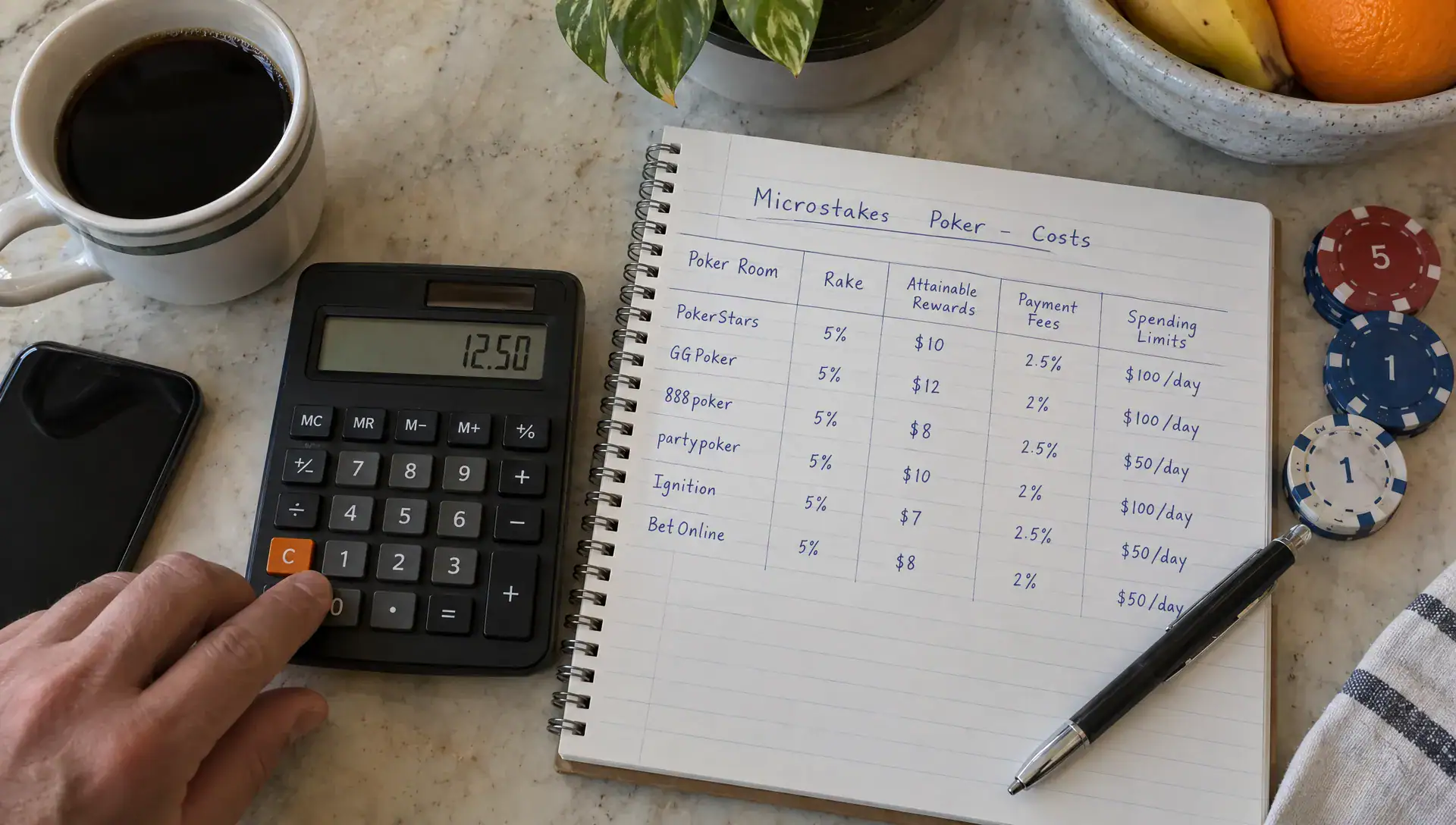
Check the entire deposit-to-withdrawal route
A convenient deposit method may not support withdrawals. Before funding an account, identify the available withdrawal route, its minimum amount and any operator, payment-provider or currency-conversion charges.
Fixed fees deserve particular attention. A hypothetical $2 charge consumes 10% of a $20 withdrawal. That is a reason to compare payment methods, not a reason to deposit more than you can afford.
Complete required identity checks through the operator’s secure process. Names and account details should match, and payment methods may need to belong to the account holder. Cryptocurrency introduces additional considerations, including network charges, address errors and price volatility where applicable.
The best poker sites for real money should explain these requirements before you encounter them at cashout. Rakeback Bible’s guide to evaluating real-money poker withdrawals covers the distinction between review time and payment processing.
If the minimum practical withdrawal is uncomfortable relative to your entire budget, reconsider the room rather than leaving a balance you cannot conveniently access.
Evaluate software without buying unnecessary tools
For microstakes, reliable basic software matters more than elaborate graphics. Test bet sizing, decimal display, connection recovery and the visibility of balances and fees. On mobile, check whether controls are easy to use without accidental taps.
Look for hand histories, account statements and accessible support. Find the operator’s policy on disconnections rather than assuming interrupted hands will be refunded. Before multitabling, confirm that you can track action comfortably at one table.
Among the best poker sites for real money, software suitability is personal: a desktop-focused player and someone using a small phone may reasonably choose different rooms.
Check rules on heads-up displays, trackers, seating scripts and other third-party software. Permission at one room does not transfer to another. Bots, collusion and prohibited real-time assistance can lead to account restrictions and undermine game integrity.
Do not upload identity documents or detailed account information into unrelated tools. A service claiming to detect weak opponents or guarantee profits is not a substitute for transparent operator safeguards.
Keep comparison automation separate from gameplay
A spreadsheet is usually sufficient to track published rake, rewards received and payment costs. Record the source date and keep currencies consistent. Avoid paying for a sophisticated subscription that costs more than the benefit you expect to evaluate.
For a poker club or publisher maintaining a shared comparison resource, custom web and AI development can support a purpose-built terms-tracking workflow. The useful distinction is between organizing publicly available information and making decisions during live hands. Automated summaries still require human checks against the operator’s current terms.
Individual players need neither a custom platform nor an AI assistant to choose a room. Keep research outside live play, follow site rules and do not automate access to private accounts. Technology can organize evidence, but it cannot establish legal eligibility or make an unavailable reward attainable.
Run a limited trial before making a larger commitment
Once a room passes your eligibility and safety checks, test it within a fixed spending limit. Use the smallest suitable game, decline optional re-entries outside your plan and record results without trying to recover losses.
Assess the experience against the same questions you used for the shortlist:
- Did suitable games run at your planned times?
- Did charges and credited rewards match the published rules?
- Could you find statements, support and account controls?
- Were verification and withdrawal requirements clear?
A small withdrawal, where practical, can test the process. It does not prove future solvency or guarantee that every later payment will be handled identically.
A short trial also cannot establish your long-term win rate or reliably measure opponent strength. Separate observable service quality from whether you happened to win that week.
The best poker sites for real money are those that remain suitable after this practical check, not those that merely delivered a favorable first session. If a key condition fails, stop and reassess. Do not make additional deposits to qualify for better treatment or recover the cost of testing.
Frequently asked questions
What counts as microstakes poker? There is no universal boundary. The term commonly describes the smallest cash games and low-buy-in tournaments, but actual stakes vary by room. Always compare the displayed blinds, entry fees and permitted buy-ins rather than relying on the label.
Is higher rakeback always better? No. A larger percentage can leave you paying more if the underlying rake is higher. Eligibility rules, release thresholds and expiry also affect the benefit. Compare cash-equivalent rewards actually received against the charges attributable to your play.
Can US players use every internationally licensed room? No. International licensing does not establish permission in a particular US state. Verify local requirements and the operator’s authorization for the specific product. Do not treat successful registration or a marketing claim as legal confirmation.
Do I need to keep tax records for small stakes? Keep records of play, deposits, withdrawals, fees and promotional credits. Small stakes do not automatically eliminate tax obligations, and a payment statement may not capture the relevant taxable activity. Consult current IRS guidance and an appropriately qualified tax professional about your circumstances.
How should beginners identify the best poker sites for real money? Start with lawful access and player protections, then compare available games, effective costs and spending controls. Free play can help you learn the interface without risking money. No operator choice makes poker a dependable income source.
Choose the room that fits your limits
Use Rakeback Bible’s reviews and deal comparisons to identify candidates, then verify the relevant terms directly with each operator. Prioritize eligible access, suitable microstakes traffic and manageable total costs over headline rewards. If a room only looks attractive after increasing your stakes, playing longer or stretching your budget, it is not the right fit.
Author