
How to Find the Best Poker Bonuses for Your Monthly Volume


The best poker bonuses are the ones your normal monthly play can actually unlock, not necessarily the offers with the largest advertised amounts. A $600 match can release less cash than a $100 promotion if your volume is modest or the clearing deadline is short.
The useful comparison is cash you can realistically collect, plus compatible rewards, against the costs of your existing play. Start with your usual workload, translate each offer into achievable payments and reject anything that requires you to stretch your bankroll or playing schedule.
Build a monthly volume baseline
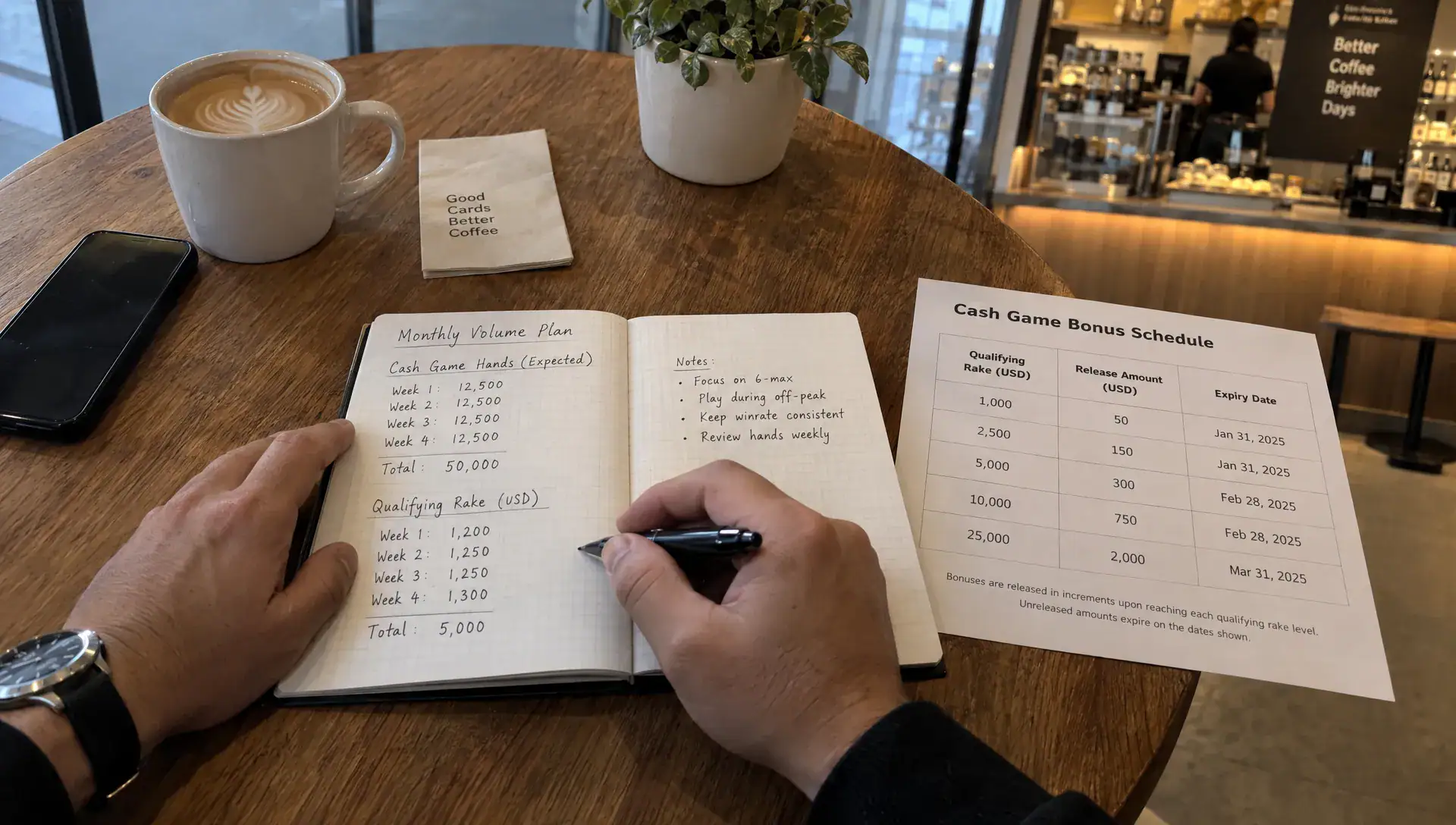
Use your last two or three representative months, rather than your busiest month. Record cash-game hands or tournament entries, playing hours and the rake or entry fees shown in your account history. New players should use a modest schedule instead of assuming they will immediately play every evening.
Build a low, normal and high case. For example, 10,000 cash-game hands at an observed average of $0.03 in attributed rake per hand imply $300 in monthly rake. At 6,000 hands, the same assumption produces $180. These are hypothetical inputs, not estimates for any particular stakes or room.
For tournaments, separate the prize-pool contribution from the fee. If 100 entries each include a $1 qualifying fee, your starting estimate is $100 in fees, not the total amount paid in buy-ins. Check whether reentries and your chosen tournament formats qualify.
Monthly qualifying volume = expected activity × observed qualifying rake or fees per unit.
The best poker bonuses should fit that existing workload. Use your lower-volume forecast for an affordability check, especially if work, travel or family commitments regularly interrupt your schedule.
Check location and eligibility before comparing value
An attractive promotion is irrelevant if you cannot legally access the room or are excluded from the offer. For US players, check state-specific authorization for real-money online poker, not merely whether a website accepts registrations or advertises a foreign license.
Use your state gaming regulator’s official website to confirm the operator and product. For example, the New Jersey Division of Gaming Enforcement’s internet gaming information provides an official starting point for checking that market. Approval for another gambling product does not automatically establish approval for peer-to-peer online poker.
Rakeback Bible’s guide to choosing poker sites by state explains how to approach this initial screening.
Then check age, physical-location requirements, new-customer status, permitted payment methods and any account or household exclusions. An existing account can disqualify you from a welcome promotion even if you never deposited. Complete this screening before spending time calculating an offer’s potential return.
Calculate what the best poker bonuses will actually release
A deposit match usually describes the maximum bonus you can activate, not cash immediately available to withdraw. Your deposit amount, qualifying activity, release schedule and deadline determine how much becomes usable money. Read those conditions together.
Convert the release rules into dollars
Suppose a hypothetical offer releases $20 for every $100 in qualifying rake. If your eligible deposit activates a $200 bonus cap, the full amount would require $1,000 in qualifying rake.
At $500 in qualifying rake before expiry, you would release five $20 installments, or $100. The remaining $100 would not become cash unless you completed the additional requirements within the deadline.
For an offer that pays only completed installments, use:
Released cash = the smaller of your activated cap or completed release units × cash per unit.
Completed release units equal qualifying rake divided by the rake required per unit, rounded down. At $490 in the example above, only four installments release, producing $80 rather than $98. If the terms instead allow proportional release, that rounding rule would not apply.
Match the forecast to the actual clearing window. A rough 45-day estimate might start with 1.5 times your monthly volume, but adjust for holidays and planned breaks. A seven-day promotion needs a seven-day forecast.
When evaluating the best poker bonuses, treat unreleased amounts as conditional, not as money already earned. Also check whether partial progress expires and whether released funds carry further restrictions.
Compare offers at the same qualifying volume
Consider two hypothetical offers. Offer A releases $20 per $100 of qualifying rake, up to $600. Offer B releases $5 per $20, up to $100. Both have a 30-day deadline and pay only completed installments.
The table assumes your eligible deposit activates the stated cap in either case. It excludes rakeback, tickets and other promotions.
| Qualifying rake within 30 days | Offer A: up to $600 | Offer B: up to $100 |
|---|---|---|
| $40 | $0 | $10 |
| $100 | $20 | $25 |
| $400 | $80 | $100 |
| $1,200 | $240 | $100 |
Offer B pays more at the first three activity levels despite its smaller headline. Offer A becomes more useful once your existing volume supports larger releases. Neither pays its advertised maximum at $1,200 in qualifying rake.
Also compare the deposit needed to activate each cap. A larger required deposit is not itself a fee, but it ties up more of your poker budget. Do not deposit money needed for household expenses just to reserve a bonus you are unlikely to clear.
This is why the best poker bonuses can differ between two players at the same stakes: their monthly activity and available bankroll may be very different.
Match the reward structure to your monthly routine
Occasional or irregular play
If some months contain only a few sessions, prioritize small release increments, manageable deadlines and rewards without demanding activity thresholds. A large cap offers little benefit when your expected play does not reach the first payment.
Model missed sessions explicitly. An offer that produces $25 in your normal month but nothing in your quieter month may be less dependable than one that releases smaller amounts progressively. Avoid treating uncertain leaderboard finishes or prize draws as guaranteed compensation.
Consistent monthly play
For steady players, compare the welcome period with an ordinary month after the introductory offer ends. A first-month advantage can disappear if ongoing rakeback is lower or useful loyalty benefits require more activity than you normally generate.
Check whether tiers reset by calendar month, whether points expire and whether a higher rate applies retroactively or only to later play. A rolling 30-day welcome offer can also span two calendar-month loyalty periods, so those calculations may need separate forecasts.
Higher monthly volume
At higher volume, caps and tier rules become more important. Calculate rewards below and above each threshold instead of applying the highest advertised percentage to every dollar of rake.
For regular players, the best poker bonuses should be judged across both the introductory window and a representative ongoing month. Keep uncertain benefits separate from cash you can calculate directly.
Adjust the forecast for your games
Cash games and poker variants
Use the promotion’s definition of attributed rake. Under a dealt method, credit may be allocated among players dealt into a hand; under a weighted-contributed method, it depends on contributions to the pot. The room’s precise implementation controls the calculation.
Do not estimate progress from the entire pot’s rake unless that is genuinely what the promotion credits to your account. Likewise, a history from one game, stake or table size may not predict another accurately. Pot-Limit Omaha, heads-up games and fast-fold formats can have different rake structures or promotional treatment.
Tournaments and restricted formats
Tournament progress commonly depends on the fee rather than the prize-pool contribution, but the offer’s terms decide what qualifies. Check satellites, freerolls, ticket-funded entries and special formats individually. A ticket’s face value is not equivalent to withdrawable cash.
Use records from the formats you already play, rather than switching games to accelerate clearing. The best poker bonuses for a cash-game regular may be unsuitable for a tournament player with the same total buy-ins because their qualifying fees and release timing differ.
Combine bonuses and rakeback without double counting
A bonus and a rakeback percentage do not always stack at their full advertised values. Some arrangements deduct bonuses from the rake used to calculate cashback; others apply offsets differently. Check the actual terms rather than adding the percentages together.
For example, assume $400 in eligible rake, an $80 released bonus and 20% rakeback. If the bonus does not affect the rakeback calculation, cashback is $80 and combined rewards total $160.
If the $80 bonus is deducted from the rakeback base first, cashback becomes 20% of $320, or $64. Combined rewards are then $144. This is an illustrative calculation, not a description of any named operator’s current offer.
Rakeback Bible’s explanation of how poker bonuses affect rakeback payments covers these interactions in more detail.
For each offer, record released cash, compatible recurring rewards and unavoidable payment or currency-conversion costs. Keep uncertain tickets, leaderboard prizes and future status benefits outside the guaranteed-cash total.
The best poker bonuses minimize your expected cost at your normal volume, rather than merely maximizing a promotional percentage. Remember that rake is already reflected in recorded poker results, so do not subtract it again when reviewing those results.
Check the value of extra play before chasing a threshold
Suppose your planned month ends just short of another release installment. That can make an extra session feel necessary, but the installment is not free money: additional play creates more rake, more exposure to losses and a time commitment.
Evaluate the offer using your original schedule first. If a deal looks attractive only after adding hours or moving up stakes, remove those assumptions and recalculate. A promotion should not determine your risk limits.
For a useful comparison, divide forecast cash rewards by qualifying rake. In the earlier $400 example, Offer A returns $80, equivalent to a 20% promotional rebate on that qualifying rake. Offer B returns $100, or 25%. These figures exclude other rewards and do not describe your overall poker profitability.
The best poker bonuses reduce costs; they do not guarantee winning results. Maintain separate deposit, loss and time limits regardless of how close you are to the next reward. If gambling becomes difficult to control, the National Council on Problem Gambling provides US support information and resources.
Activate and track the offer carefully
Before depositing, save a dated copy or screenshot of the promotion’s terms. This gives you a reference if the public page changes and helps distinguish the advertised maximum from your account’s actual eligibility.
Use a short activation checklist:
- Confirm that the offer applies to your account, location and intended payment method.
- Check whether registration through a specific link, a bonus code or an opt-in is required before depositing or playing.
- Record the activated cap, qualifying games, release increments and exact expiry time.
- Confirm withdrawal conditions, including whether a withdrawal cancels unreleased rewards.
- Verify that the promotion appears in your account before relying on projected payments.
Track qualifying progress weekly, but do not turn the tracker into a reason to play longer. If progress differs from your forecast, check rake attribution and excluded games before assuming an error.
Even the best poker bonuses are worth only what the applicable terms allow you to collect. Keep your confirmation emails and contact support promptly if activation or progress appears incorrect.
Frequently asked questions
Which poker site has the best bonus for my monthly volume? There is no universal winner. Compare legally available offers using the same forecast of qualifying rake or tournament fees, then account for release increments, deadlines, caps and interactions with ongoing rewards.
Are no-deposit poker bonuses better for low-volume players? They can provide a way to try an eligible room without an initial deposit, but availability and restrictions vary. Check identity-verification requirements, qualifying play, ticket expiry and any withdrawal limits. A promotional ticket should not be valued like cash.
Should I choose a longer deadline or a higher advertised amount? Calculate both outcomes using your actual schedule. The best poker bonuses for irregular players often offer enough time and small enough installments to produce useful payments without extra sessions. A longer deadline alone does not fix an unsuitable clearing rate.
What happens if I do not clear the full bonus? The terms determine whether you keep completed releases, lose unfinished progress or face other conditions. Do not assume partial progress pays proportionally. Check what happens at expiry and after a withdrawal before claiming the offer.
Shortlist offers using your own numbers
Once you have checked local availability, use Rakeback Bible’s poker deal comparisons to build a shortlist, then verify each promotion’s current operator terms.
Compare your low and normal monthly forecasts side by side. Favor the offer that delivers useful, collectable rewards within your existing budget and schedule, even when its advertised maximum is smaller.
